



If you’ve spent any time browsing bike forums or scrolling through used-bike listings, you’ve probably come across the name Kawasaki Ninja 500 more than once. It’s one of those motorcycles that somehow manages to stay relevant decade after decade. The 2025 version sitting in Kawasaki showrooms today and the carbureted 2002 Kawasaki Ninja 500 your friend’s older cousin might have owned share almost nothing mechanically, yet they’re both loved for very similar reasons — an approachable twin-cylinder engine, a comfortable riding position, and a price tag that doesn’t make your eyes water the way a superbike would.
This post is a deep dive into the Kawasaki Ninja 500 from every angle that actually matters to a buyer or an enthusiast: current pricing, real-world top speed, the engine that powers it, how the bike has evolved since the early 2000s, and what people are doing with it in terms of streetfighter conversions, cafe racer builds, and everyday mods. Grab a coffee, this one’s a long read.
Kawasaki Ninja 500 Price in India 2025
Let’s start with the question almost everyone actually wants answered first: how much does it cost?
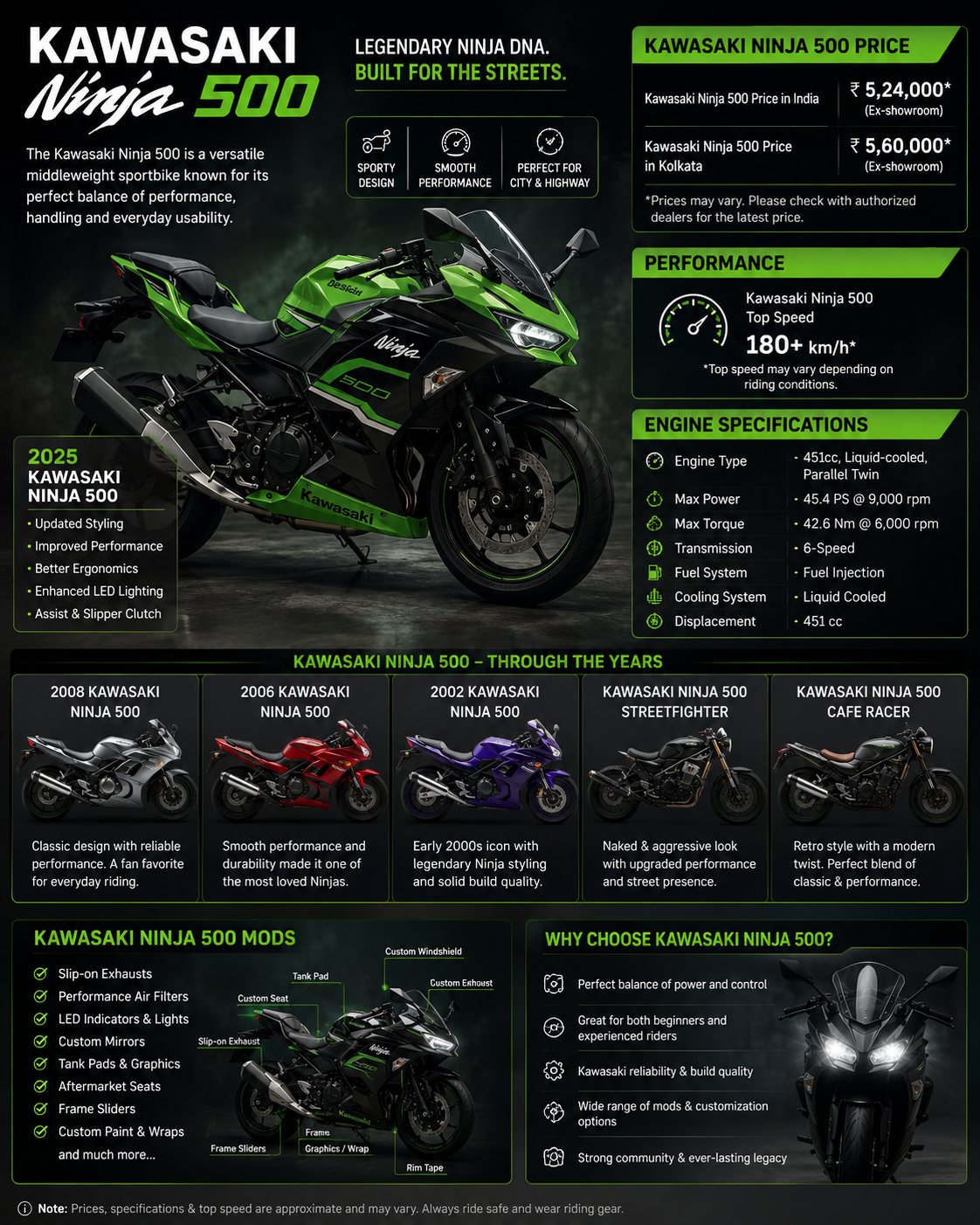
Kawasaki rolled out an updated version of the bike for 2025, and the Kawasaki Ninja 500 price in India now sits in the range of roughly ₹5.29 lakh to ₹5.66 lakh, ex-showroom, depending on which dealer listing and which colour variant you’re looking at. The small price bump over the previous year’s model came mainly because the bike had to be updated to meet the newer BS6 Phase 2 OBD2B emission norms that became mandatory for all vehicles sold in India from April 2025 onward.
Once you add registration, insurance, and road tax on top of the ex-showroom figure, the on-road price typically lands somewhere between ₹5.8 lakh and ₹6.5 lakh, and this is where city-specific pricing starts to matter a lot.
Kawasaki Ninja 500 Price in Kolkata
People searching specifically for the Kawasaki Ninja 500 price in Kolkata usually find that the on-road cost runs a bit higher than the national average ex-showroom figure, largely because of West Bengal’s road tax structure and local insurance premiums. As a rough ballpark, expect the on-road price in Kolkata to land somewhere in the ₹6 lakh to ₹6.5 lakh bracket. It’s always worth walking into your nearest Kawasaki dealership in the city for the exact, current on-road quote, since taxes and insurance premiums do shift from year to year and RTO charges aren’t identical across every zone within the city.
If budget is tight, it’s also worth checking with the dealership whether any seasonal discounts are running. Kawasaki India has offered discounts of up to ₹40,000-45,000 on select models during certain months, so timing your purchase can genuinely save you money.
Kawasaki Ninja 500 Top Speed
This is the number that gets thrown around the most in bike group chats, and unsurprisingly it’s a little inflated in casual conversation. The real-world Kawasaki Ninja 500 top speed sits in the range of around 170-180 km/h, depending on rider weight, wind conditions, gearing, and whether you’re tucked in or sitting upright.
That figure comes from the 451cc parallel-twin engine producing close to 45 horsepower, paired with a six-speed gearbox that’s tuned more for usable midrange punch than for outright top-end pull. This isn’t a bike built to chase triple-digit speedometer numbers on a racetrack; it’s built to be quick, confident, and easy to ride hard in the real world — overtaking on highways, carving through twisty ghat roads, and still being civil enough for a daily commute.
For context, riders who’ve owned both the older Ninja 400 and the current Ninja 500 generally report that the bike feels marginally quicker off the line thanks to the extra torque, even though the claimed top speed hasn’t changed dramatically.
Kawasaki Ninja 500 Engine
The heart of the current-generation Ninja 500 is a 451cc, liquid-cooled, parallel-twin engine with fuel injection. It produces approximately 44.7-45.4 PS at around 9,000 rpm and roughly 42.6 Nm of torque at 6,000 rpm. That torque figure is actually a small step up from the outgoing Ninja 400, which is one of the few genuine mechanical changes Kawasaki made when it rebranded and relaunched the bike as the Ninja 500.
What makes this Kawasaki Ninja 500 engine likeable isn’t raw numbers on a spec sheet, though. It’s the character. Parallel-twin engines in this displacement bracket tend to feel buzzy or flat in the midrange, but Kawasaki has tuned this one to pull cleanly from low revs all the way to its limiter, which makes city riding far less of a chore than you’d expect from a “sporty” 450cc machine. The assist-and-slipper clutch also lightens up the clutch lever noticeably, something riders upgrading from smaller commuter bikes will appreciate within the first few kilometres.
Fuel efficiency, for what it’s worth, hovers around 21-23 kmpl in real-world riding, which is respectable for a bike in this performance category.
A Quick Look Back: The History of the Kawasaki Ninja 500
Here’s where things get genuinely interesting, because the “Ninja 500” name has actually been around far longer than most current buyers realise.
2002 Kawasaki Ninja 500
The 2002 Kawasaki Ninja 500 — sold in several markets as the EX500 or Ninja 500R — was a budget-friendly, lightweight sportbike powered by a carbureted 498cc parallel-twin engine. It wasn’t flashy, it wasn’t packed with electronics, but it earned a cult following because it was cheap to maintain, easy to ride, and genuinely fun on a winding road. A huge number of new riders in North America and parts of Asia learned to ride on this generation of the bike.
2006 Kawasaki Ninja 500
By the time the 2006 Kawasaki Ninja 500 rolled around, the platform had barely changed — and that was kind of the point. Kawasaki understood that this bike’s appeal was its simplicity and reliability rather than cutting-edge tech. Minor cosmetic tweaks and colour updates were really the only things separating model years through most of the mid-2000s.
2008 Kawasaki Ninja 500
The 2008 Kawasaki Ninja 500 carried the same basic formula forward, right at a point when Kawasaki was preparing to eventually phase the EX500 platform out in favour of newer, more modern small-displacement sportbikes. For many riders, the 2006-2008 window represents the “sweet spot” of the older generation — refined enough to be dependable, simple enough to be cheap to fix.
It’s worth noting that this older 500 lineage and the modern 2025 Ninja 500 are not the same bike mechanically — they just share a name and a similar place in Kawasaki’s lineup as the brand’s entry point into sporty twins.
Kawasaki Ninja 500 Streetfighter Builds
Not everyone wants their Ninja wrapped in plastic fairings, and that’s exactly why the Kawasaki Ninja 500 streetfighter scene exists. Streetfighter builds typically strip away the front fairing and bodywork, swap in a round or minimalist headlight, raise the handlebars slightly for a more aggressive, upright riding stance, and sometimes shorten the rear subframe for a tighter, more naked-bike silhouette.
The appeal is obvious if you’ve ever seen one done well: the parallel-twin engine and tubular frame look genuinely good without the fairing covering them up, and the bike ends up feeling lighter and more flickable in city traffic. It’s a popular project among riders who already own an older EX500-based Ninja 500 and want a unique, one-of-a-kind machine rather than another stock-looking sportbike.
Kawasaki Ninja 500 Cafe Racer Conversions
The Kawasaki Ninja 500 cafe racer trend leans in the opposite direction, aesthetically. Instead of an aggressive naked-bike look, builders go for that classic, retro silhouette — a tucked-in tail section, a round headlamp, clip-on handlebars mounted low, and often a single, slim seat. Paint jobs tend to favour matte colours, brushed metal tank panels, or vintage racing stripes.
What makes the Ninja 500 (especially the older carbureted models) such a good cafe racer donor bike is the simplicity of its frame and the relatively low cost of parts. You’re not cutting into an expensive, electronics-heavy modern motorcycle, which makes the whole project far less stressful and considerably cheaper than building a cafe racer from a newer bike.
Popular Kawasaki Ninja 500 Mods
Beyond full streetfighter or cafe racer transformations, there’s a long list of smaller, more practical Kawasaki Ninja 500 mods that owners commonly go for:
- Exhaust upgrades — an aftermarket slip-on not only deepens the exhaust note but often shaves off a bit of weight too.
- Suspension tuning — adjustable rear shocks and improved fork internals sharpen up handling, especially on bikes that have done a fair number of kilometres.
- Tyre upgrades — swapping to a grippier set of tyres is one of the most noticeable, cost-effective upgrades you can make.
- LED lighting — both for visibility and styling, LED headlight and indicator swaps are common.
- Frame sliders and crash protection — sensible for anyone planning to ride the bike hard or take it on track days.
- Custom seats — particularly popular on older Ninja 500 models where the stock seat tends to get uncomfortable on longer rides.
- ECU tuning — on the fuel-injected modern Ninja 500, a simple fuel mapping adjustment can smooth out throttle response.
None of these mods turn the Ninja 500 into a different motorcycle, but together they let owners personalise the bike to their riding style, whether that’s commuting, weekend touring, or the occasional track day.
Should You Buy the Kawasaki Ninja 500?
If you’re cross-shopping the 2025 Kawasaki Ninja 500 against rivals like the Aprilia RS 457 or the Benelli 502C, the decision usually comes down to brand trust, service network, and how much you value Kawasaki’s reputation for engine reliability over outright performance numbers. The Ninja 500 isn’t the fastest bike in its segment, nor does it have the most premium feature list, but it’s an honest, well-rounded sportbike that’s friendly to new riders while still having enough character to keep experienced riders entertained.
For someone hunting for an older, more affordable project bike, the early-2000s Ninja 500 (EX500) generation remains one of the best-value platforms out there for streetfighter or cafe racer builds, simply because parts are cheap, the mechanicals are simple, and there’s a large enough community of owners online to help troubleshoot any issues.
Final Thoughts
The Kawasaki Ninja 500 nameplate has quietly built one of the most interesting legacies in the small-sportbike world — from the humble, carbureted 2002 and 2006 models that taught a generation of riders the basics, to the modern, fuel-injected 2025 version that’s currently turning heads in Indian showrooms. Whether you’re after the latest model’s price and top speed figures, curious about its engine character, or thinking about converting an older one into a streetfighter or cafe racer project, this bike has stayed relevant for a reason: it’s genuinely fun to ride and easy to live with.
If you’re in the market right now, check current Kawasaki Ninja 500 price in India and Kawasaki Ninja 500 price in Kolkata listings at your nearest dealership, take a test ride, and decide for yourself whether this twin-cylinder Ninja earns a spot in your garage.