










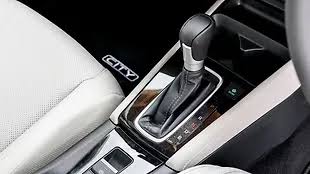
When people search for “Honda City gear,” they’re usually trying to decide between two things: which transmission to pick when buying new, or how to understand the gearbox behaviour in a car they already own. Let’s cover both angles simply.
The Two Honda City Gear Options
Honda City currently comes with two transmission choices:
- Manual Transmission (MT) – A traditional 5-speed or 6-speed manual gearbox, depending on the model year
- CVT (Continuously Variable Transmission) – An automatic gearbox that doesn’t use fixed gear steps like a conventional automatic
Both options are available across most trims, though the manual tends to be more affordable and is often preferred by buyers who drive frequently on highways or enjoy more control over the car.
How the Manual Honda City Gear Works
The manual Honda City gear shifter is a conventional H-pattern gearbox. Most owners find it smooth and light, which is one of Honda’s long-standing strengths. Key points:
- Clutch feel is generally light, making city driving less tiring
- Gear shifts are precise with minimal notchiness
- Fuel efficiency is usually slightly better than the CVT counterpart
- Ideal for drivers who prefer engine braking and manual control, especially on hilly routes
How the Honda City CVT Gear Works
The CVT variant doesn’t have traditional “gears” in the way a manual does. Instead, it uses a belt-and-pulley system that adjusts continuously to keep the engine in its optimal power band. This means:
- No jerks between gear shifts since there technically aren’t discrete gears
- Smoother acceleration, especially appreciated in heavy traffic
- A rubber-band effect on hard acceleration, where engine revs rise before speed catches up, which some drivers need time to get used to
- Slightly higher price compared to the manual variant
Honda has also included paddle shifters or a manual mode on some CVT variants, simulating gear steps for drivers who want a bit more control without a full manual clutch.
Common Honda City Gear Issues Owners Ask About
A few recurring questions come up in owner forums and service centres:
“Why does my Honda City gear feel stiff when cold?” This is common in manual variants during colder mornings or after long periods of inactivity. It usually resolves once the engine and gearbox oil warm up.
“Is the CVT gearbox reliable long-term?” Honda’s CVT units have generally proven reliable when serviced on schedule. Skipping CVT fluid changes is the most common cause of long-term issues, so this isn’t something to overlook.
“Which Honda City gear option is better for city traffic?” Most owners find the CVT more relaxed in stop-and-go traffic simply because there’s no clutch pedal to manage repeatedly.
“Which is better for highway driving?” The manual transmission tends to edge ahead here, offering slightly better control during overtaking and marginally better fuel efficiency at sustained highway speeds.
Maintenance Tips for Honda City Gearbox
Regardless of which transmission you choose, a few habits go a long way:
- Get gearbox oil (manual) or CVT fluid checked at recommended service intervals
- Avoid riding the clutch in manual variants, as this accelerates wear
- In CVT variants, avoid flooring the accelerator repeatedly from a standstill, as it puts extra strain on the belt system
- Always use manufacturer-recommended fluid grades during servicing
Manual or CVT: Which Should You Choose?
If you’re a daily city commuter dealing with heavy traffic, the CVT genuinely makes life easier. If you drive frequently on highways, enjoy a more engaging drive, or want to save a bit on the purchase price, the manual Honda City gear option remains a solid, dependable choice.
Final Thoughts
There’s no universally “better” Honda City gear option, it really depends on your daily driving pattern and personal preference. Both transmissions have proven dependable over the years, and Honda’s engineering on both fronts has consistently received positive feedback from long-term owners across India.