






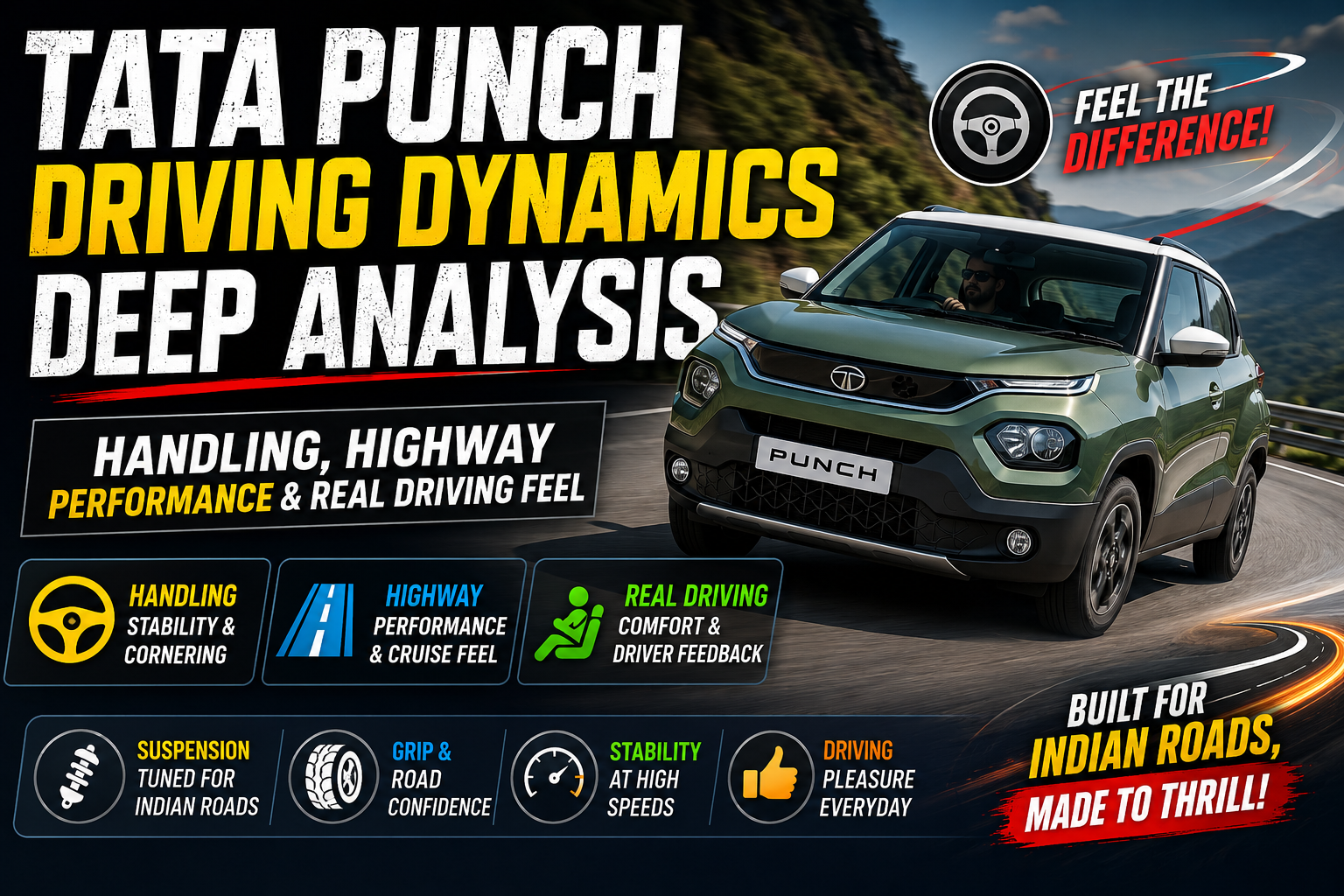
Most Tata Punch reviews talk about mileage, features, safety ratings, and specifications.
But here’s the truth: none of those numbers tell you what it’s actually like to drive the car every day.
A specification sheet won’t tell you how confident you feel while overtaking on a highway. It won’t explain how the suspension handles a badly broken road after monsoon season. And it certainly won’t tell you whether you’ll still enjoy driving the Punch six months after buying it.
That’s exactly what this review is about.
Over the years, Tata Motors has built a reputation for making safe and robust vehicles, and the Punch has become one of the brand’s biggest success stories. Sitting between a hatchback and a compact SUV, it promises the practicality of a city car with the confidence and road presence of an SUV.
But how does it actually perform when the road gets rough, traffic gets chaotic, and highways stretch for hundreds of kilometres?
After spending considerable time driving the Tata Punch in real-world conditions, here’s what stood out.
First Impression: The Driving Position Makes an Immediate Difference
The moment you settle into the driver’s seat, the Punch feels different from a typical hatchback.
You’re seated higher, visibility is excellent, and you get a clear view of traffic ahead. In crowded cities where lane discipline is often optional, this elevated seating position becomes a genuine advantage.
Whether you’re navigating busy market roads or squeezing through narrow streets, the Punch gives you a sense of confidence that many small cars simply can’t match.
For first-time SUV buyers, this is one of the biggest reasons the Punch feels special from day one.
Steering Feel: Light Where It Should Be, Stable When It Matters
One of the most impressive aspects of the Tata Punch is how naturally the steering has been tuned.
In city traffic, the steering feels light and effortless. Parking is easy, U-turns don’t require excessive effort, and low-speed manoeuvres feel stress-free.
As speed increases, the steering gains weight gradually. This creates a reassuring sense of stability on highways and prevents the vehicle from feeling nervous at higher speeds.
What stands out is the balance.
The steering isn’t overly sharp, but it never feels disconnected from the road either. For everyday driving, Tata has struck a sweet spot between comfort and control.
Suspension Performance: The Punch’s Biggest Strength
If there is one area where the Punch genuinely shines, it’s ride quality.
Indian roads can change dramatically within a few kilometres. Smooth highways quickly turn into broken patches, potholes, and uneven surfaces.
The Punch handles these situations remarkably well.
The suspension absorbs small imperfections effortlessly while larger potholes are dealt with in a controlled manner. Instead of sending harsh impacts into the cabin, the vehicle remains composed and comfortable.
This is especially noticeable on poorly maintained urban roads where many competitors begin to feel unsettled.
The Punch simply gets on with the job.
City Driving Experience
The Punch feels perfectly suited to urban environments.
The combination of compact dimensions, light steering, excellent visibility, and comfortable suspension makes daily commuting easy.
Traffic jams feel less stressful, parking becomes simpler, and navigating tight streets rarely feels intimidating.
For buyers spending most of their time inside city limits, the Punch delivers exactly what they need from a modern compact SUV.
City Driving Rating: 9/10
Highway Performance: Comfortable, Not Sporty
Take the Punch onto the highway, and its personality remains largely unchanged.
At speeds between 80 km/h and 100 km/h, the vehicle feels stable, relaxed, and confidence-inspiring.
The steering remains predictable, the suspension stays composed, and long journeys are comfortable.
However, once speeds climb beyond 100 km/h, the limitations of the naturally aspirated petrol engine become more noticeable.
Overtaking requires more planning, wind noise increases, and the engine starts working harder.
That doesn’t make the Punch a poor highway vehicle.
It simply means the car is designed for comfortable cruising rather than enthusiastic performance driving.
For the majority of Indian buyers, that’s perfectly acceptable.
Engine Performance: Smooth but Not Exciting
The Tata Punch focuses on drivability rather than outright speed.
Power delivery is smooth and predictable, making the car easy to drive in everyday situations.
Within the city, performance feels adequate and relaxed.
On highways, however, quick overtakes require patience and planning.
Drivers expecting turbocharged levels of acceleration may feel underwhelmed, but buyers prioritizing fuel efficiency and daily usability are unlikely to complain.
The engine does its job without drama.
Handling and Cornering Confidence
Despite its SUV-inspired design, the Punch feels surprisingly composed around corners.
Body roll is present, as expected, but it remains well controlled.
The car responds predictably to steering inputs and never feels unstable or top-heavy.
This confidence becomes particularly valuable on winding roads where predictable behavior matters far more than outright speed.
The Punch may not be a driver’s car, but it is an easy car to trust.
Rough Roads and Broken Surfaces
This is where the Punch truly earns its popularity.
Large potholes, uneven village roads, poorly repaired city streets, and aggressive speed breakers are all handled with confidence.
The generous ground clearance means you spend less time worrying about scraping the underbody and more time enjoying the drive.
For Indian road conditions, this practical advantage cannot be overstated.
Many owners consider it one of the best aspects of living with the Punch.
Braking Performance
Braking performance is reassuring and predictable.
The pedal offers good progression, allowing smooth braking in traffic while still providing enough stopping power during emergency situations.
ABS intervention feels natural, and the vehicle remains stable under hard braking.
For a family-oriented compact SUV, the braking setup inspires confidence.
Cabin Refinement and NVH Levels
The Punch performs reasonably well in terms of refinement, though this is an area where its price point becomes noticeable.
At city speeds, cabin noise remains acceptable.
At highway speeds, wind noise, tire noise, and engine sound become more apparent.
While not intrusive, the Punch isn’t among the quietest vehicles in its segment.
Buyers moving from premium sedans may notice this immediately.
Who Should Buy the Tata Punch?
The Punch makes the most sense for buyers who
- Drive primarily in cities
- Frequently encounter poor road conditions
- Want SUV-like visibility
- Prioritise comfort over performance
- Need strong ground clearance
- Value safety and practicality
Final Verdict: How Good Is the Tata Punch to Drive?
The Tata Punch succeeds because it focuses on the fundamentals.
It isn’t designed to be fast.
It isn’t designed to be sporty.
Instead, it delivers something more valuable for most buyers: confidence.
The excellent suspension, comfortable driving position, predictable handling, and impressive rough-road capability make it one of the most practical compact SUVs currently available.
If your priority is comfortable, stress-free driving on real Indian roads rather than chasing performance figures, the Tata Punch remains one of the smartest choices in its segment.
Driving Dynamics Scorecard
| Category | Rating |
|---|---|
| City Driving | 9/10 |
| Ride Comfort | 8.5/10 |
| Steering Feel | 8/10 |
| Suspension Performance | 9/10 |
| Highway Stability | 8/10 |
| Braking Confidence | 8/10 |
| Engine Performance | 7/10 |
| NVH Levels | 7/10 |
| Rough Road Capability | 9/10 |
| Overall Driving Experience | 8.5/10 |