









India’s National Automobile Scrappage Policy: Driving Sustainability and Economic Growth
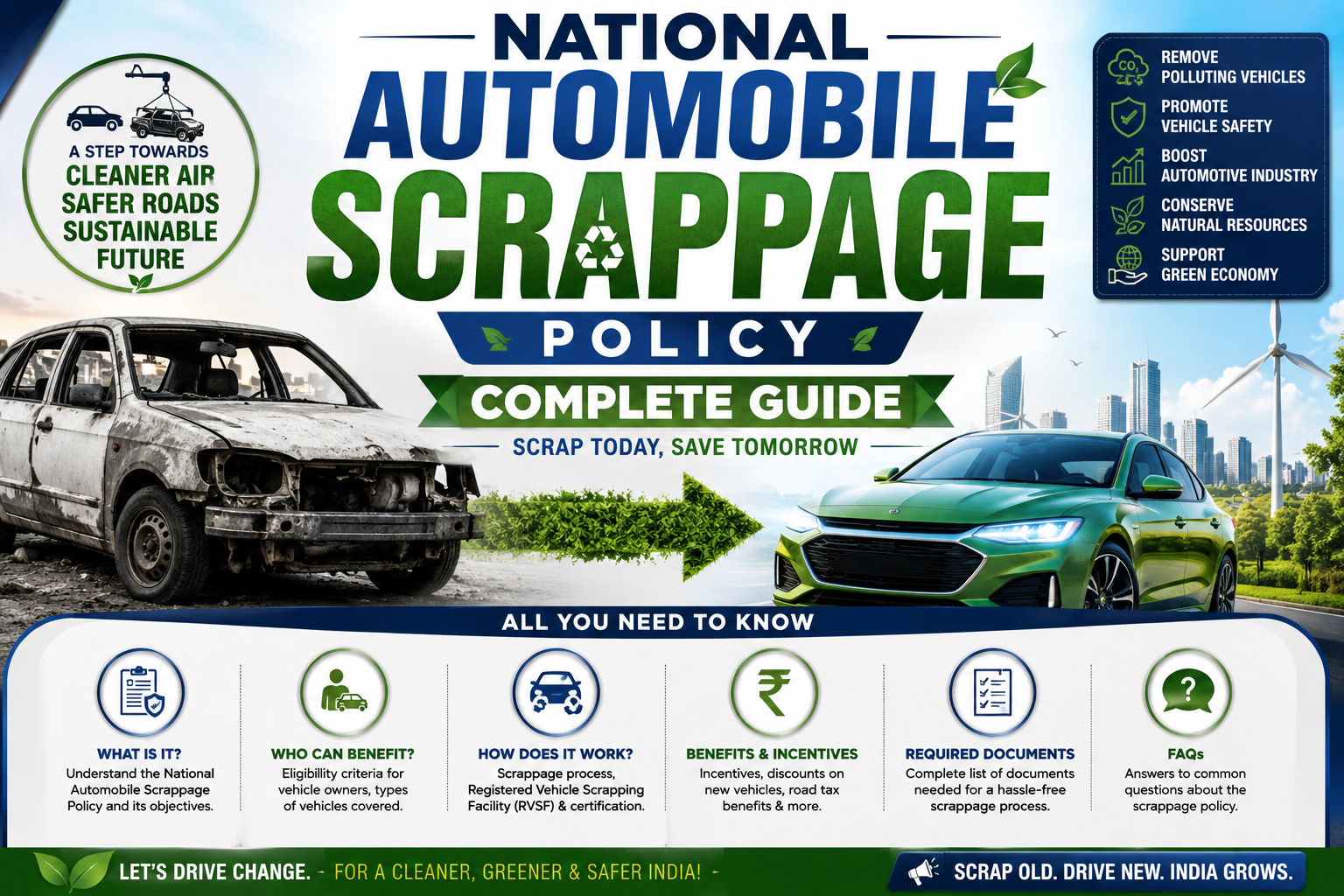
In August 2021, the Government of India announced the National Automobile Scrappage Policy – a groundbreaking initiative to replace ageing vehicles with new ones while promoting environmental sustainability and supporting the automobile industry.
This policy represents a paradigm shift in how India manages vehicle life cycles and environmental concerns. It incentivises owners to retire old, polluting vehicles and purchase new, efficient ones, creating a win-win situation for the environment, the economy, and vehicle owners.
What is the National Automobile Scrappage Policy?
The scrappage policy is a government scheme to encourage owners of old vehicles to voluntarily scrap their vehicles in exchange for financial incentives and benefits.
Core Objectives:
Environmental Impact:
- Reduce emissions from aging, inefficient vehicles
- Decrease air pollution, particularly in metropolitan areas
- Promote sustainable transportation
Economic Stimulus:
- Boost automobile industry demand
- Create employment in scrapping facilities and new vehicle sales
- Increase government revenue through GST on new vehicles
Vehicle Safety:
- Remove unsafe, poorly maintained vehicles from roads
- Reduce accidents caused by mechanical failures
Industry Support:
- Stimulate demand in the automobile sector during slowdown periods
- Create a market for new vehicles
Eligibility Criteria for Vehicle Scrapping
Vehicle Requirements:
Commercial Vehicles:
- Minimum 10 years old (from date of registration)
- Must be registered with the transport authority
Personal Vehicles (Cars, SUVs):
- Minimum 15 years old from the date of registration
- Must have valid registration
Two and Three-Wheelers:
- Minimum 15 years old at registration
- Specific eligibility conditions apply
Condition of Vehicle:
- The vehicle must be in running condition
- No condition about accident or damage history (though severely damaged vehicles may be rejected)
- The vehicle should be roadworthy to reach the scrapping facility
Documentation Requirements:
- Valid RC (Registration Certificate)
- Proof of ownership
- Valid insurance (preferable)
- PUC (Pollution Under Control) certificate
- No pending loans or legal disputes on the vehicle
Financial Incentives Under the Policy
The policy offers substantial incentives for scrapping vehicles:
Trade-in/Scrap Value:
The government offers standardised scrap values based on vehicle type and age:
Passenger Vehicles:
- Vehicles 15-19 years old: 4-6% of the original price
- Vehicles 20+ years old: 6-8% of original price
Example: A ₹10 lakh car purchased 16 years ago might fetch ₹40,000-50,000 as scrap value.
Commercial Vehicles:
- Scrap value: Higher than that of passenger vehicles due to material value
- Commercial vehicles 10-14 years old: 6-8% of the original price
- Commercial vehicles 15+ years old: 8-10% of original price
Additional Tax Incentives:
When purchasing a new vehicle, a scrappage policy offers the following:
GST Exemption:
- 25% GST exemption on purchase of a new vehicle (in some scenarios)
- Reduces the effective cost of a new vehicle
Registration Fee Exemption:
- Exemption from new registration fees
- Saves approximately ₹3,000-10,000 depending on vehicle type
Example Cost Savings:
Suppose you own a 16-year-old ₹10 lakh car:
Without the Scrappage Policy:
- Car resale value: ₹2-3 lakhs
- Cost of new car: ₹8-10 lakhs
- Total investment: ₹5-8 lakhs additional
With the Scrappage Policy:
- Scrap value: ₹40,000-50,000
- GST benefit on new car: ₹50,000-100,000
- Registration fee savings: ₹5,000
- Total benefits: ₹95,000-155,000
Net savings: ₹1-1.5 lakhs approximately
Implementation and Authorized Scrapping Centers
Authorised Vehicle Scrapping Facilities (AVSFs):
The government has authorised specific scrapping facilities across India:
Facility Requirements:
- AVSF must meet the Ministry of Road Transport standards
- Must have proper environmental compliance
- Must follow dismantling and disposal procedures
- Must issue a scrapping certificate
Current Authorised Facilities: Approximately 140+ AVSFs are operational across India as of 2024, with more being added.
State-wise Distribution:
- Maharashtra: 20+ facilities
- Uttar Pradesh: 15+ facilities
- Gujarat: 12+ facilities
- Tamil Nadu: 10+ facilities
- Other states: Scattered facilities
Process at Scraping Centres:
- Vehicle inspection and assessment
- Document verification
- Deregistration from RTO
- Physical scrapping and material recycling
- Issuance of the scrapping certificate
- Payment of scrap value (usually after 2-4 weeks)
Application and Implementation Process
Step-by-Step Process for Vehicle Owner:
Step 1: Identify Authorized Scrapping Facility
- Check the government’s VAHAN portal for the nearest AVSF
- Verify facility credentials
- Inquire about the process and timeline
Step 2: Visit the Scraping Facility
- Bring vehicle RC, insurance, PUC, and ownership proof
- Get the vehicle inspected
- Receive a quote for scrap value
Step 3: Submit Documents
- Submit original RC and supporting documents
- AVSF processes the deregistration request with RTO
- Receive acknowledgment
Step 4: Vehicle Scrapping
- Schedule the vehicle scrapping date
- Drive vehicle to facility (or arrange transport)
- Physical scrapping and material recycling
- AVSF receives a scrapping certificate from RTO
Step 5: Receive Payment and Benefits
- Receive scrap value payment (usually 2-4 weeks)
- Obtain a scrapping certificate
- Use the certificate and scrap value for a new vehicle purchase
- Claim GST benefits at the dealer
Step 6: Purchase New Vehicle
- Select a new vehicle from a participating dealer
- Provide a scrapping certificate
- Dealer helps process GST exemption and other benefits
- Complete new vehicle registration
Timeline: The complete process typically takes 4-8 weeks from the scoping decision to the new vehicle purchase.
Impact and Performance of Scrappage Policy
Adoption Statistics:
As of December 2024:
- Approximately 350,000+ vehicles have been scrapped under the policy
- Expected to reach 1 million by 2025
- Commercial vehicles: Higher adoption rate (30-35% eligible vehicles)
- Personal vehicles: Lower adoption rate (5-8% eligible vehicles)
Despite financial incentives, the adoption of the scrappage policy by personal vehicle owners remains low:
Sentimentality:
- People are emotionally attached to personal vehicles
- Often view vehicles as investments rather than consumables
Alternative Options:
- Higher resale value in the private market vs. scrap value
- Even 16-year-old car can fetch ₹3-4 lakhs in used market vs. ₹40,000-50,000 scrap value
Purchase Unwillingness:
- Even with incentives, the new vehicle cost is substantial
- Many owners continue using old vehicles indefinitely
Commercial Vehicle Adoption: Commercial vehicles have higher adoption due to the following:
- Business cost considerations
- Fleet management efficiency
- Tax benefits for businesses
- Wear and tear on commercial vehicles
Environmental Impact
Emissions Reduction:
Each 15+ year-old vehicle removed from roads reduces annual emissions:
CO₂ Reduction:
- Average car: 5-6 tonnes of CO₂ annually
- Commercial vehicle: 10-12 tonnes of CO₂ annually
Particulate Matter Reduction: Older vehicles (pre-2000) emit significantly higher particulate matter (PM2.5 and PM10).
Target Impact: If 1 million vehicles are scrapped by 2030, the estimated annual emissions reduction is 5-6 million tonnes of CO₂ equivalent.
Material Recycling:
Scrapped vehicles provide recyclable materials:
- Steel: 75% of vehicle weight
- Aluminum: 5-8%
- Plastics: 8-10%
- Other materials (glass, fluids): Remaining
Recycling rate at authorised facilities: 85-90%.
Challenges and Criticisms
Low Adoption Among Personal Vehicle Owners:
The primary challenge is convincing personal vehicle owners to scrap vehicles:
Weak Incentive Structure:
- Scrap value is significantly lower than the used market value
- Even with benefits, incentives don’t justify scrapping
Used Car Market Competition:
- A robust used car market offers higher values
- Owners prefer selling to private buyers
Structural Issues:
Limited Scrapping Facility Network:
- Only 140+ facilities for 300+ million vehicles on roads
- Inconvenient locations for many owners
Awareness Gap:
- Many owners are unaware of the policy’s existence
- Lack of active government promotion
Implementation Bottlenecks:
- RTO coordination delays
- Deregistration process bureaucratic
- Payment delays at facilities
Environmental Concerns:
Informal Scrapping:
- A significant portion of old vehicles is scrapped informally
- Improper disposal of toxic materials
- Environmental pollution from informal scrapping
Integration with Formal System:
- Bringing informal scrapping into the formal system challenging
- Requires coordination between AVSF and informal operators
Future Outlook and Improvements
Government Initiatives:
Facility Expansion: The government aims to increase scrapping facilities to 500+ by 2030.
Technology Integration:
- Digital tracking of scrapped vehicles
- Real-time benefit processing
- Online application systems
Enhanced Incentives:
- Potential increase in tax benefits
- Possible subsidy enhancement for EV purchases with scrapping
Commercial Vehicle Focus: Given better adoption in the commercial segment, policy may focus on fleet replacement programmes.
Reasons for Low Personal Vehicle Adoption:
faq
| Q: What is the minimum age for vehicle scrapping under this policy? A: Commercial vehicles must be 10+ years old. Passenger vehicles and two/three-wheelers must be 15+ years old. |
| Q: How much compensation will I get for scrapping my vehicle? A: Scrap value typically ranges from 4 to 8% of the original vehicle price, depending on vehicle type and age. A ₹10 lakh car might fetch ₹40,000-80,000. |
Q: Is the scrappage policy mandatory? A: No, it’s completely voluntary. Vehicle owners can choose to scrap or continue using their vehicles. |
| Q: What GST benefits are available under the policy? A: Eligible buyers may receive up to a 25% GST exemption on a new vehicle purchase when scrapping an old vehicle. |
| Q: How long does the scrapping process take? A: The complete process typically takes 4-8 weeks from the scoping decision to final benefits receipt. |
| Q: Can I scrap a vehicle with an outstanding loan? A: No, the vehicle must be loan-free. A lender’s No Objection Certificate (NOC) is required. |
| Q: Where are authorised scrapping facilities located? A: Check the government’s VAHAN portal for authorised vehicle scrapping facilities (AVSFs) near your location. |
| Q: Will scrapping my vehicle affect my insurance? A: Scrapping deregisters the vehicle, making the existing insurance void. New insurance is required for the new vehicle. |