

Hero MotoCorp: The Undisputed King of India’s Two-Wheeler Market
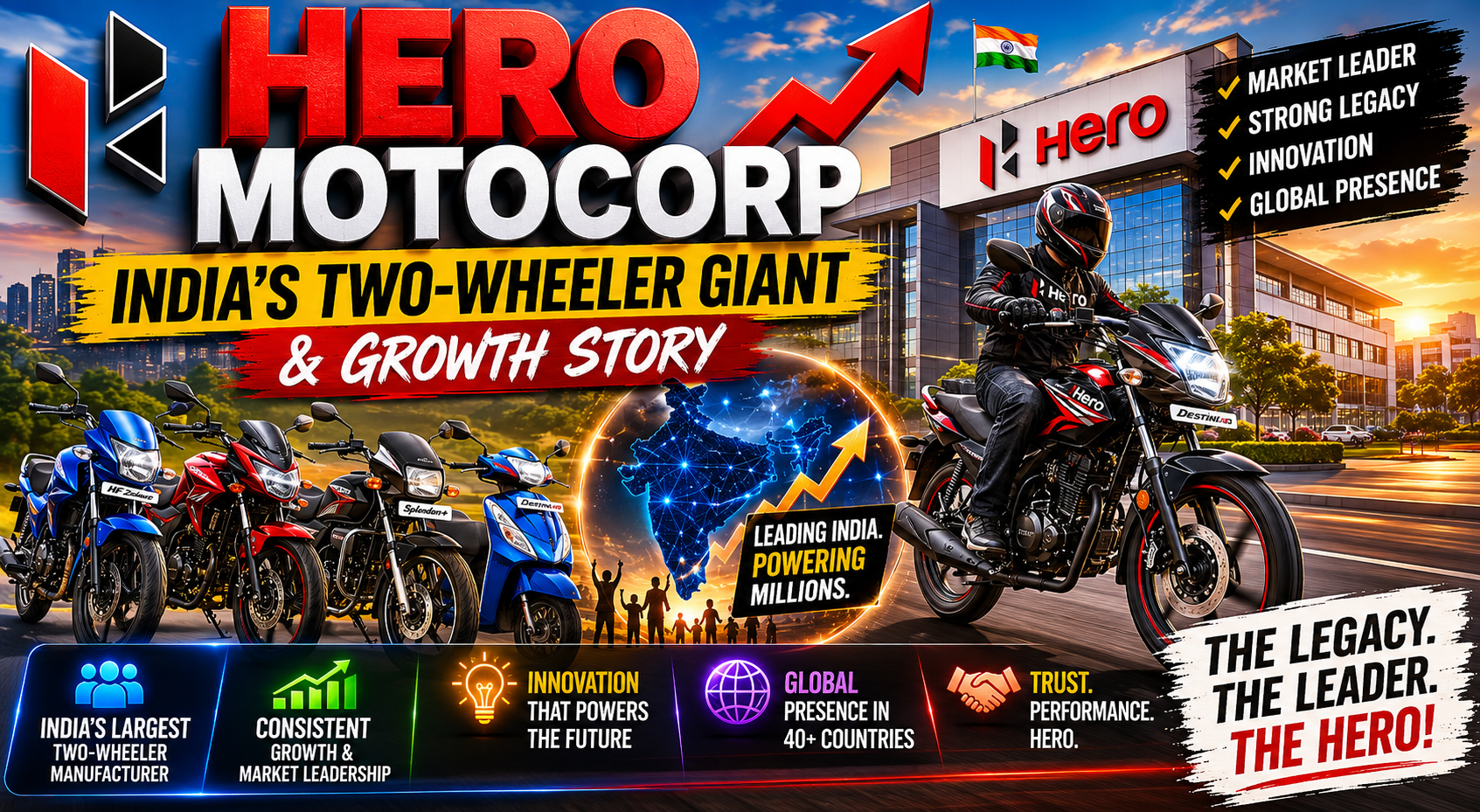
If India’s automobile industry has a crown jewel in the two-wheeler segment, it’s undoubtedly Hero MotoCorp. Since its founding in 1956 as Hero Cycles, the company has evolved into the world’s largest two-wheeler manufacturer by volume.
The numbers tell the story: Hero MotoCorp sells one motorcycle or scooter every two seconds in India. The company commands approximately 35-40% market share in the two-wheeler segment, significantly ahead of competitors Honda, Bajaj, TVS, and Mahindra.
Company Overview and History
Founding and Evolution:
Hero MotoCorp was founded in 1956 as Hero Cycles Ltd. The company entered the two-wheeler motorcycle segment in 1956 and expanded significantly in the 1980s.
In 1984, Hero Cycles entered into a joint venture with Honda Motor Company, creating Hero Honda Motors Limited. This partnership was transformational, bringing Japanese engineering and technology to Indian motorcycles.
By 2009, Hero MotoCorp became a wholly independent entity after acquiring Honda’s stake (70.3% in September 2011).
Key Milestones:
- 1956: Founded as Hero Cycles
- 1980s: Entered motor cycle segment
- 1984: JV with Honda established
- 1989: Splendor motorcycle launched (game-changing product)
- 2001: Company achieved 1 million cumulative sales
- 2009: Became an independent company
- 2011: Acquired Honda’s remaining stake
- 2015: 100 millionth two-wheeler sold
- 2020: Launched the electric two-wheeler segment
- 2025: Continuing market leadership with EV expansion
Market Position and Market Share
Current Market Standing:
- Market share: 35-40% of the two-wheeler segment
- Annual sales: 6.5-7 million units
- Revenue: ₹40,000+ crores annually
- Profit margins: 8-10% (decent for two-wheeler segment)
- Dealership network: 12,000+ service and sales points across India
Competitive Positioning:
Hero MotoCorp leads but faces increasing competition:
- Honda (second position, ~17-18% share): Positioned as quality-focused, premium segment
- Bajaj (third position, ~15-16% share): Aggressive on pricing and rural penetration
- TVS (fourth position, ~12-13% share): Strong in South India
- Mahindra (emerging player, ~5% share): Recently entered the two-wheeler segment
Despite competition, Hero maintains leadership through brand loyalty, extensive distribution, and continuous product innovation.
Product Portfolio
Motorcycle Segment (Core Business):
Splendor Series (Best-selling motorcycle worldwide):
- Splendor, Splendor Plus, Splendor Pro: Entry-level commuter motorcycles
- Price range: ₹50,000-60,000
- Sales: Over 5 million cumulative units sold
- Target market: First-time bike buyers, daily commuters
Passion Series:
- High-performance commuter segments
- Price range: ₹75,000-90,000
- Features: Sporty design, performance focus
Glamour Series:
- Stylish commuter motorcycles
- Price range: ₹65,000-75,000
- Target market: Young professionals wanting style
Karizma and Hunk Series:
- Sports and performance segment
- Price range: ₹1.2-1.5 lakhs
- Premium positioning for enthusiasts
Scooter Segment (Growing):
- Maestro: Economy scooter positioning
- Pleasure: Spacious, comfortable scooter
- Destini: Affordable commuter scooter
- Duet: Dual-positioning scooter
- Price range: ₹50,000-80,000
Electric Vehicle Segment (Emerging):
- Hero Electric brand: Dedicated EV line
- Hero e-Scooter: Entry into electric two-wheelers
- Products: Hero Hydrogen (fuel cell scooter prototype)
- Strategy: Building EV portfolio for future growth
Revenue and Financial Performance
Revenue Streams:
Two-wheeler sales: Primary revenue driver, contributing 85-90% of total revenue. Spare parts and accessories: Significant recurring revenue. After-sales service: Provides steady cash flow. Financial services: Financing solutions through hero-backed NBFC Insurance: Partnership for insurance products
Financial Metrics:
- Annual revenue: ₹40,000+ crores
- Net profit: ₹3,500-4,500 crores annually
- Profit margin: 8-10%
- Return on equity: 15-18%
- Debt levels: Moderate, manageable
- Cash reserves: Substantial
Revenue Growth Trends:
Despite market saturation, Hero achieves growth through:
- Rural market penetration
- Export expansion
- EV product line
- Replacement cycle demand
Annual growth rate hovers around 5-8%, lower than the tech sector but stable and reliable.
Strategic Challenges and Opportunities
Current Challenges:
Market Saturation: India’s two-wheeler market is increasingly saturated in urban areas. Growth comes primarily from rural markets with limited purchasing power.
Electric Vehicle Transition: The shift from petrol to electric is slow in India due to charging infrastructure gaps, high battery costs, and consumer skepticism about EV reliability.
Chinese Competition: Chinese manufacturers are aggressively entering India with lower-priced electric two-wheelers, posing a threat.
Declining Profit Margins: Rising raw material costs, labor expenses, and competitive pricing pressure erode profit margins.
Technology Investment: Keeping up with global automotive technology requires continuous R&D investment.
Future Opportunities:
EV Market Leadership: First-mover advantage in EV two-wheelers could position Hero as the leader in the emerging segment.
Export Markets: Two-wheelers are in demand globally. Expanding exports to Southeast Asia, Africa, and Latin America provides growth.
Rural Market Penetration: 70% of India’s population lives in rural areas. Tailored products and financing solutions unlock this market.
Subscription Models: Rather than ownership, subscription models for transportation could create new revenue streams.
Technology Integration: Connected two-wheelers, GPS tracking, and advanced features appeal to younger demographics.
Manufacturing Operations
Production Capacity:
- Annual capacity: 9+ million units
- Manufacturing facilities: Multiple plants across India
- Key locations: Gurugram (Haryana), Rajasthan, Bihar, Uttarakhand
- Capacity utilization: ~70-80%
Manufacturing Excellence: Hero has adopted:
- Lean manufacturing principles
- Quality management systems (ISO certifications)
- Automation in assembly
- Supply chain optimization
Supply Chain: Hero manages the supply chain through:
- Tier-1 suppliers (major component manufacturers)
- Tier-2 and Tier-3 suppliers (small-scale manufacturers)
- Just-in-time inventory management
- Strong supplier relationships
Distribution and Service Network
Dealership Network:
- 12,000+ authorized dealers and service centers
- Coverage: Urban, semi-urban, and rural India
- Service capability: Basic maintenance to major repairs
Distribution Strategy:
- Direct dealer agreements
- Regional distributors managing inventory
- Effective logistics for spare parts
After-Sales Service:
- Preventive maintenance programs
- Original spare parts availability
- Warranty coverage
- Extended service packages
The extensive network is Hero’s competitive advantage, ensuring customers get service easily.
Corporate Social Responsibility
Hero MotoCorp invests in:
Education:
- Scholarship programs for underprivileged students
- Skill development centers
- Support for rural education
Environmental Initiatives:
- Energy-efficient manufacturing
- Waste management programs
- Tree-planting initiatives
- Water conservation
Road Safety:
- Helmet donation programs
- Road safety awareness campaigns
- Partnerships with the government on safety initiatives
Future Growth Strategy
EV Expansion: Hero is aggressively expanding its EV portfolio, targeting 20% of sales from electric two-wheelers by 2030.
International Expansion: Targeting markets in Southeast Asia, Africa, and Latin America for export growth.
Technology and Innovation:
- Connected two-wheelers
- Advanced safety features
- Fuel-efficient engines
- Electric powertrains
Market Segmentation: Creating products for different market segments:
- Ultra-budget segment (₹45,000-55,000)
- Value segment (₹55,000-75,000)
- Premium segment (₹1-1.5 lakhs)
- Electric segment (emerging)
FAQs: Hero MotoCorp
| Q: Is Hero MotoCorp the world’s largest two-wheeler manufacturer? A: By volume, yes. Hero MotoCorp sells over 6 million units annually, more than any other two-wheeler manufacturer globally. Q: What is Hero MotoCorp’s market share in India? A: Hero MotoCorp commands approximately 35-40% of India’s two-wheeler market, significantly ahead of all competitors. Q: How many dealerships does Hero have? A: Hero operates 12,000+ authorised dealers and service centres across India, providing extensive coverage. Q: Is Hero MotoCorp profitable? A: Yes, Hero MotoCorp is highly profitable, reporting annual net profits of ₹3,500-4,500 crore with profit margins of 8-10%. Q: What is Hero MotoCorp’s strategy for electric vehicles? A: Hero is expanding its EV portfolio through its Hero Electric brand, targeting 20% EV sales by 2030. Q: What happened to Hero’s joint venture with Honda? A: Hero acquired Honda’s remaining stake in 2011, becoming a fully independent company. Q: Which is Hero’s best-selling product? A: The Splendour series is the world’s best-selling motorcycle, with over 5 million cumulative sales. Q: What are Hero’s main competitors? A: Main competitors are Honda (17-18% share), Bajaj (15-16%), TVS (12-13%), and emerging players like Mahindra. |