



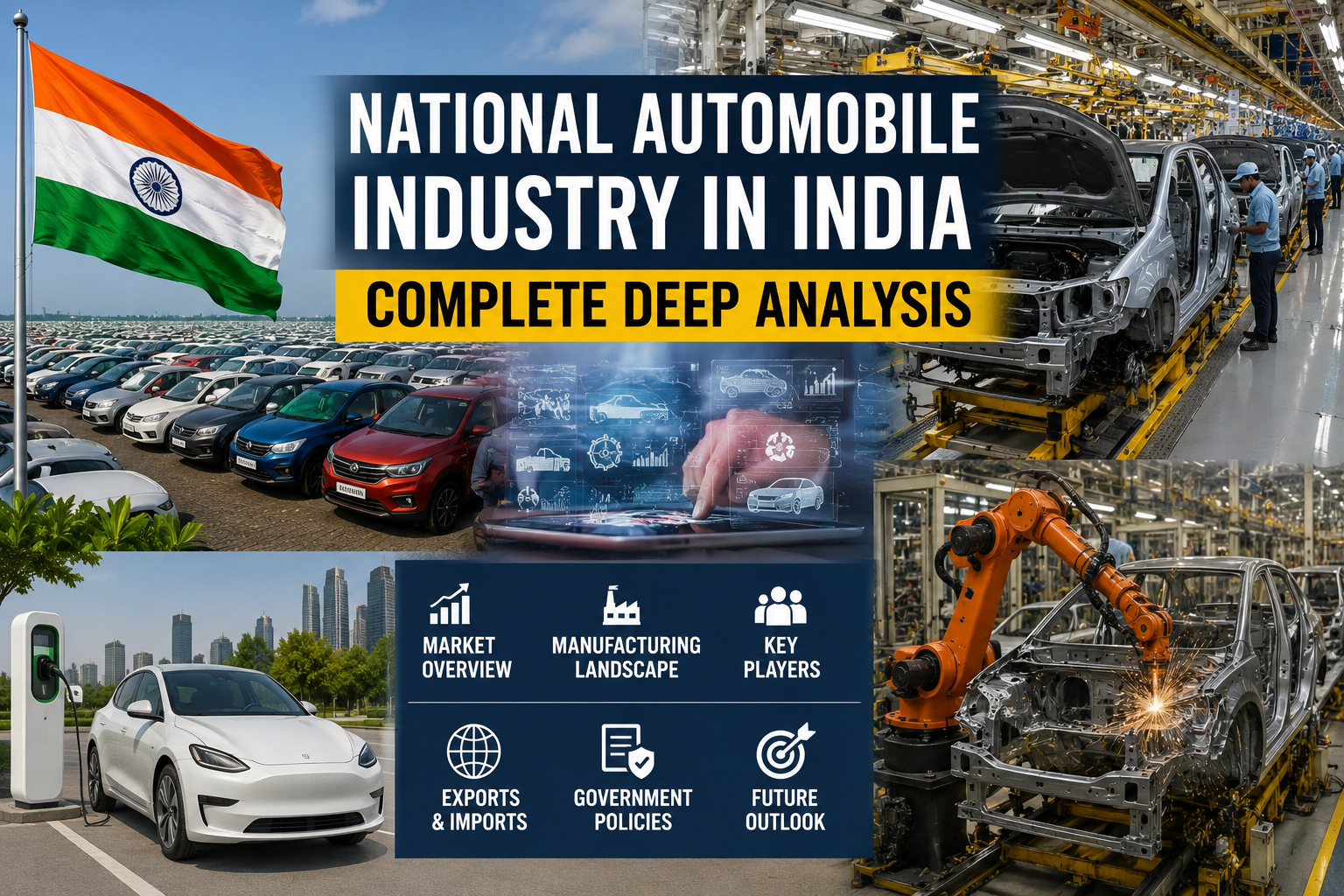
The National Automobile Industry: India’s Path to Global Manufacturing Leadership
The national automobile industry in India represents one of the most dynamic and rapidly evolving sectors of the Indian economy. Over the past three decades, the automobile sector has undergone a dramatic transformation – from a protected domestic industry to a globally competitive manufacturing hub.
Today, India stands as the world’s third-largest automobile manufacturer by volume, producing over 20 million vehicles annually. This achievement is remarkable for a country that, just 30 years ago, was producing fewer than 500,000 vehicles per year.
Historical Evolution of the National Automobile Industry in India
Phase 1: The Protected Industry Era (1950s-1980s)
When India gained independence, the national automobile industry was virtually non-existent. The government’s protectionist policies created a highly regulated sector with limited competition.
Key characteristics:
- Only Hindustan Motors and Premier Automobiles operated in the early years
- Ambassador and Padmini became iconic cars
- Production was extremely limited
- Waiting periods for vehicles are extended to 5-7 years
- Prices were high due to limited supply
By 1980, the national automobile industry produced only about 250,000 vehicles annually – less than what a single modern manufacturing plant produces today.
Phase 2: The Liberalisation Period (1991-2005)
The 1991 economic liberalisation fundamentally changed the national automobile industry. Foreign manufacturers were gradually allowed entry into the Indian market.
Transformational changes:
- Hero Honda entered the two-wheeler segment (1984–1991)
- Maruti Suzuki revolutionised passenger vehicles (1983 onwards)
- Japanese technology companies entered the market
- Competition intensified dramatically
- Quality standards improved significantly
- Prices became more competitive
This period saw explosive growth. By 2005, the national automobile industry was producing 1.8 million vehicles annually – a 7-fold increase from 1980.
Phase 3: The Modern Growth Era (2005-Present)
From 2005 onwards, India’s national automobile industry entered a high-growth trajectory.
Major developments:
- Indian manufacturers became globally competitive
- Exports began growing rapidly
- Technology advancement accelerated
- SUV segment emerged and boomed
- The two-wheeler market exploded
- Three-wheeler segment formalised
- The electric vehicle transition began
By 2024, the national automobile industry was producing 20+ million vehicles annually.
Current Market Size and Scale
Production Statistics (FY 2023-24):
Passenger Vehicles:
- Annual production: 3.8 million units
- Market value: ₹3.5 lakh crores
- Growth rate: 8-10% annually
- Major players: Maruti, Hyundai, Tata, Mahindra, Kia
Commercial Vehicles:
- Annual production: 1.0 million units
- Market value: ₹1.2 lakh crores
- Growth rate: 6-8% annually
- Major players: Tata, Mahindra, Ashok Leyland, Bharat Benz
Two-Wheelers and Three-Wheelers:
- Annual production: 16+ million units
- Market value: ₹10 lakh crores
- Growth rate: 5-7% annually
- Dominates by volume (80% of total vehicle production)
Total National Automobile Industry:
- Annual production: 20+ million vehicles
- Market size: ₹15 lakh crores
- Growth rate: 10-12% annually
- Employment: 40+ million people
Economic Contribution to the Indian Economy
Revenue and Financial Metrics:
The national automobile industry contributes significantly to India’s overall economy:
Sectoral Output:
- Automobile manufacturing: ₹8.5 lakh crores
- Automotive components: ₹4.2 lakh crores
- Automotive retail and services: ₹2.3 lakh crores
- Total value addition: ₹15 lakh crores
Percentage of National Economy:
- Represents 12-13% of manufacturing output
- Contributes 2.5-3% to the national GDP
- Accounts for 4-5% of total exports
- Employs 40+ million people (direct and indirect)
Export Performance:
The national automobile industry has become a significant exporter:
Export Statistics:
- Annual export value: ₹2.5 lakh crores
- Export volume: 3.5+ million vehicles
- Export destinations: 190+ countries
- Major export markets: Japan, USA, UK, Germany, South Korea
Export breakdown:
- Passenger vehicles: 800,000+ units annually
- Commercial vehicles: 200,000+ units annually
- Two-wheelers: 2.5+ million units annually
- Auto components: ₹100,000+ crores worth
This makes India a significant automotive exporter globally.
Major Players in the National Automobile Industry
The Passenger Vehicle Segment:
Maruti Suzuki (Market Leader)
- Market share: 43%
- Annual sales: 1.7+ million vehicles
- Key models: Swift, Alto, Baleno, Brezza, Celerio
- Manufacturing capacity: 2.1 million vehicles annually
- Strengths: Cost efficiency, reliability, extensive network
Hyundai Motor India (Second Position)
- Market share: 17%
- Annual sales: 650,000+ vehicles
- Key models: Creta, i20, Venue, Elantra, Verna
- Manufacturing capacity: 700,000 vehicles annually
- Strengths: Product quality, design, features
Tata Motors (Third Position)
- Market share: 10-12%
- Annual sales: 400,000+ vehicles
- Key models: Nexon, Harrier, Tigor, Punch
- Portfolio: Diverse – cars, SUVs, commercial vehicles
- Strengths: Design innovation, SUV expertise
Mahindra & Mahindra (Fourth Position)
- Market share: 9-10%
- Annual sales: 350,000+ vehicles
- Key focus: SUVs and commercial vehicles
- Key models: XUV500, Bolero, Scorpio
- Strengths: SUV market leader, off-road capability
Kia Motors (Emerging Player)
- Market share: 5%
- Annual sales: 200,000+ vehicles
- Key models: Seltos, Sonet, Carens
- Manufacturing capacity: 500,000 vehicles (underutilised)
- Strengths: International brand, premium positioning
Renault and Nissan (Combined 3-4%)
- Nissan phase-out in India
- Renault is focusing on the budget segment
- Annual sales: 100,000+ vehicles combined
The Two-Wheeler Segment:
Hero MotoCorp (Dominant Leader)
- Market share: 35-40%
- Annual sales: 6.5+ million units
- Products: Motorcycles, scooters
- Strengths: Brand loyalty, extensive network
- Manufacturing capacity: 9+ million units annually
Honda Motorcycle (Second Position)
- Market share: 16-18%
- Annual sales: 1.0+ million units
- Positioning: Quality-focused, premium segment
- Key models: CB series, Activa scooters
Bajaj Auto (Third Position)
- Market share: 15-16%
- Annual sales: 1.0+ million units
- Positioning: Aggressive pricing, rural penetration
- Key strength: Wide geographic coverage
TVS Motor (Fourth Position)
- Market share: 12-13%
- Annual sales: 800,000+ units
- Regional strength: Strong in South India
- Key focus: Quality and performance
The Commercial Vehicle Segment:
Tata Motors (Leader)
- Market share: 35-40%
- Annual sales: 350,000-400,000 units
- Products: Trucks, buses, tippers
- Global presence: Significant international operations
Mahindra & Mahindra (Second)
- Market share: 20-25%
- Specific strength: Light and medium commercial vehicles
Ashok Leyland (Third)
- Market share: 15-18%
- Specific strength: Buses and heavy trucks
Bharat Benz (Emerging)
- Market share: 5-8%
- Growing presence in the truck segment
Employment Generation in the National Automobile Industry
Direct Employment:
The national automobile industry provides direct employment to over 900,000 people:
Job breakdown:
- Manufacturing workers: 400,000+
- Engineers and supervisors: 150,000+
- Dealers and sales staff: 200,000+
- Service technicians: 150,000+
Wage levels:
- Unskilled workers: ₹10,000-15,000 monthly
- Skilled workers: ₹15,000-30,000 monthly
- Technicians: ₹20,000-40,000 monthly
- Engineers: ₹40,000-100,000+ monthly
Indirect Employment:
Beyond direct manufacturing, the industry supports 40+ million people indirectly:
Indirect employment includes the following:
- Component suppliers: 8+ million people
- Dealers and distributors: 5+ million people
- Servicenter users: 3+ million people
- Transportation and logistics: 10+ million people
- Finance and insurance: 2+ million people
- Steel and raw materials: 8+ million people
- Research and development: 500,000+ people
This makes the national automobile industry one of India’s largest employers.
Government Policies Supporting the National Automobile Industry
Make in India Initiative
Launched in 2014, this overarching policy aims to:
- Attract global automotive companies to manufacture in India
- Support domestic manufacturers to become globally competitive
- Create quality jobs
- Establish supply chains
Automotive policy under Make in India:
- Tax incentives for manufacturing
- Infrastructure support
- Skill development programs
- Research and development support
Production-Linked Incentive (PLI) Scheme (2020)
This scheme offers incentives to manufacturers meeting specific targets:
PLI for Automobile and Auto Components:
- Incentives: 4-5% of incremental sales value
- Target: Increase manufacturing and reduce imports
- Specific focus: Electric vehicles
- Expected impact: ₹50,000+ crores additional investment
FAME Scheme (Faster Adoption and Manufacturing of Hybrid and Electric vehicles)
Object incentivise
- Incentivize electric vehicle adoption
- Support EV manufacturing infrastructure
- Develop a charging infrastructure
Benefits:
- Direct subsidies for EV buyers
- Charging station subsidies
- Manufacturing support
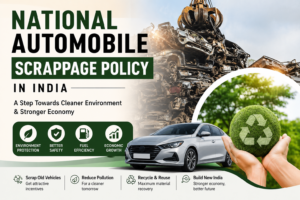
National Automobile Scrappage Policy (2021)
Already discussed in detail, this policy:
- Encourages the retirement of old vehicles
- Provides financial incentives
- Promotes environmental sustainability
- Supports new vehicle demand
National Vehicle Scrappage Authorises
- Authorizes scrapping facilities
- Monitors policy implementation
- Ensures environmental compliance
Manufacturing Hubs and Regional Distribution
Tamil Nadu – The Automotive Hub
Position: Accounts for 25-30% of India’s automobile production
Major facilities:
- Hyundai Motor India: Sriperumbudur
- Renault-Nissan: Oragadam
- Kia Motors: Anantneighbouringboring state)
- TVS Motor: Hosur
- Daimler India: Chakan (nearby)
Advantages:
- Port connectivity for exports
- Established supplier ecosystem
- Government support
- Skilled workforce
Gujarat – Industrial Powerhouse
Major facilities:
- Maruti Suzuki: Kalol, Vadodara
- General Motors: Halol (discontinued)
- Tata Motors: Multiple facilities
- Mahindra: Kutch
Advantages:
- Business-friendly policies
- Manufacturing tradition
- Road connectivity
- Tariff benefits
Maharashtra – Traditional Manufacturing Base
Major facilities:
- Tata Motors: Jamshedpur (Jharkhand) and Pune
- Bajaj Auto: Multiple locations
- Mahindra: Nashik
Delhi-NCR Region
Major facilities:
- Maruti Suzuki: Gurugram, Manesar
- Hero MotoCorp: Multiple facilities
- Component manufacturers: Scattered across the region
Emerging Hubs:
Telangana and Andhra Pradesh:
- Kia Motors: Anantapur
- Sunmobility: EV focus
- Emerging as an electric vehicle hub
Karnataka:
- TVS Motor: Mysore
- Other component manufacturers
Haryana:
- Component manufacturing hub
- Supporting the Delhi-NCR auto industry
Technology Evolution in the National Automobile Industry
Engine Technology
BS (Bharat Stage) Emission Norms:
India has implemented increasingly stringent emission standards:
BS-VI (Current Standard):
- Implemented April 2020
- Particulate matter reduction: 95% below BS-IV
- NOx reduction: 70% below BS-IV
- CO₂ reduction: Focus on fuel efficiency
BS-VII and BS-VIII: Under consideration for future implementation
Engine Efficiency:
- Modern engines achieve 15-18 km/l in petrol vehicles
- Diesel engines achieve 18-22 km/l
- Hybrid technology is improving efficiency further
Transmission Technology
Manual Transmissions:
- 5-speed standard in the budget segment
- 6-speed is becoming common in mid-range
Automatic Transmissions:
- CVT (Continuously Variable Transmission)
- DCT (Dual-Clutch Transmission)
- Torque converter automatics
- More affordable automatic options emerging
Electric and Hybrid Technology
India’s transition to electrification is accelerating:
Current EV Production:
- Electric vehicles: 350,000+ units annually
- Hybrid vehicles: Growing segment
- Electric two-wheelers: 500,000+ units annually
Battery Technology:
- Lithium-ion dominance
- Cost reduction: From ₹15 lakhs/kWh (2010) to ₹5-7 lakhs/kWh (2024)
- Range improvements: 250-400 km becoming standard
- Charging speed: 30-80% in 20-30 minutes, possible
Future Technologies:
Autonomous Driving:
- Level 2-3 autonomous features appearing in premium vehicles
- Level 4-5 autonomous vehicles: Under development by global players
- India-specific development: Limited focus currently
Connected Vehicles:
- Internet of Things (IoT) integration
- Real-time data transmission
- Predictive maintenance
- Vehicle-to-vehicle communication
Alternative Fuels:
- Hydrogen fuel cells: Experimental stage in India
- Bioethanol blending: Government pushing E20 fuel
- Natural gas: CNG vehicles are popular in certain segments
Challenges Facing the National Automobile Industry
Supply Chain Disruptions
Semiconductor Shortage:
- Post-pandemic disruption affected production
- Specific impact: Automatic transmission vehicles affected
- Timeline: Gradually normalising by 2024
Raw Material Costs:
- Steel price volatility
- Semiconductor costs elevated
- Rubber and plastic cost increases
Transition to Electric Vehicles
Challenge complexity:
- Technology transition requires massive R&D investment
- Supply chain restructuring needed for batteries
- Charging infrastructure inadequate
- The battery recycling ecosystem is lacking
- Consumer skepticism about EV reliability
Current EV adoption: Only 2-3% of vehicle sales
Infrastructure Limitations
Charging Infrastructure:
- Public charging points: Only 8,000-10,000 across India
- Requirement for mass adoption: 500,000+ charging points
- Private charging accessibility: Limited to apartment dwellers
Road Infrastructure:
- Many roads inadequate for heavy vehicles
- Congestion in urban areas
- Highway quality varies significantly
Labor and Skill Issues
Skill Gaps:
- Shortage of skilled manufacturing workers in some areas
- EV technology expertise limited
- Digital skills inadequate
Labour Mobility:
- Migration for better opportunities
- Wage pressure from competing sectors
Competition and Margins
Domestic Competition:
- Increasing number of manufacturers
- Price pressure from competition
- Profit margins compressed
International Competition:
- Chinese EV manufacturers eyeing India
- Global manufacturers establishing presence
- Price competition from imports
Environmental Compliance
BS-VI Compliance Costs:
- Required catalytic converter improvements
- Particulate filter technology
- Cost increased vehicle prices by 8-12%
Waste Management:
- Vehicle disposal and recycling
- Battery waste management
- Fluid and part recycling challenges
Economic Outlook for the National Automobile Industry
Growth Projections:
Experts predict:
- Industry to grow at 12-15% CAGR through 2030
- Market size reaching ₹25-30 lakh crores by 2030
- Production capacity exceeding 25 million vehicles annually
EV Transition:
- EV sales projected at 20-25% of total by 2030
- Battery production capacity to increase 10-fold
- Charging infrastructure to expand dramatically
Export Growth:
- Export value to reach ₹5 lakh crores by 2030
- EV exports are becoming significant
- Component exports’ continuing growth
Technology Integration:
- Autonomous vehicle features are becoming mainstream
- Connected vehicle technology standard
- Alternative fuels are gaining traction
Employment Growth:
- An additional 10+ million jars are expected
- Shift towards skilled technical roles
- EV and software expertise in high demand
Government’s Vision 2032
The government has articulated an ambitious vision for the national automobile industry:
Auto Industry Vision 2032 targets:
- Market size of $300 billion
- Automobile exports of $150 billion
- 40% of new vehicles to be electric
- Manufacturing moving up the value chain
- India is becoming an EV manufacturing hub
Key initiatives planned:
- Greater domestic battery manufacturing
- Software and autonomous technology development
- Connected vehicle platforms
- Hydrogen fuel cell exploration
Regional Disparities in the Automobile Industry
North India:
- Maruti’s dominance in the four-wheeler segment
- Hero MotoCorp’s leadership in two-wheelers
- Growing commercial vehicle manufacturing
South India:
- Hyundai and other international players concentrated
- Established automotive cluster in Tamil Nadu
- Growing component manufacturing
West India:
- Multiple manufacturer presence
- Strong two-wheeler manufacturing (Bajaj, TVS)
- Component manufacturing hub
East India:
- Tata Motors concentration
- Emerging commercial vehicle hub
- Less developed passenger vehicle presence
FAQs: National Automobile Industry in India
Q: What is India’s position in global automobile manufacturing? A: India is the world’s third-largest automobile manufacturer by volume, producing 20+ million vehicles annually, behind only China (25+ million) and Japan (9+ million).
Q: How many people work in India’s national automobile industry? A: Directly, 900,000+ people work in automobile manufacturing. Indirectly, over 40 million people depend on the industry for employment.
Q: What is India’s automobile export value? A: India exports automobiles worth ₹2.5+ lakh crores annually to 190+ countries, making it one of the nation’s major exports.
Q: What percentage of India’s GDP comes from the automobile industry? A: The automobile industry contributes 2.5-3% to India’s national GDP and 12-13% of manufacturing output.
Q: What is India’s current electric vehicle adoption rate? A: Currently, electric vehicles represent only 2-3% of total vehicle sales. The government aims to increase this to 30% by 2030.
Q: Which is India’s largest automobile manufacturer? A: Maruti Suzuki leads in passenger vehicles with 43% market share. Hero MotoCorp dominates two-wheelers with 35-40% market share.
Q: What are the major challenges for India’s automobile industry? A: Key challenges include semiconductor shortages, EV transition complexity, infrastructure limitations, labour skill gaps, and environmental compliance costs.
Q: What is India’s target for the automobile industry by 2032? A: The government aims for a $300 billion industry size with $150 billion in exports and 40% EV penetration by 2032.