













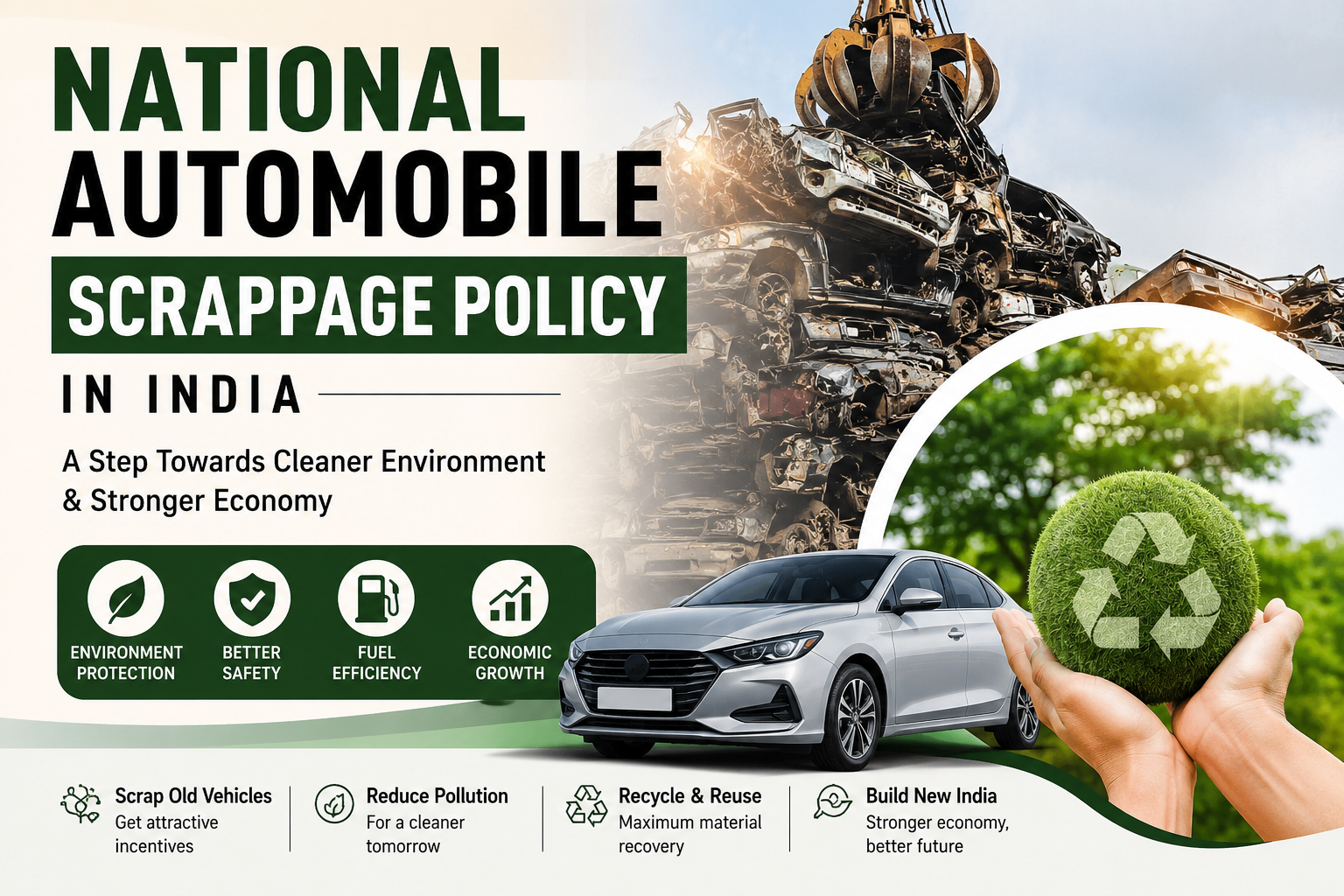
National Automobile Scrappage Policy in India: Complete Guide to Benefits, Eligibility, Process, Environmental Impact & Future Opportunities
Introduction
India is home to one of the world’s largest automobile markets, with millions of vehicles operating across cities, towns, and rural regions. Over the years, a significant number of vehicles have remained on the roads long after their optimal operational life. These ageing vehicles often contribute to higher emissions, reduced fuel efficiency, increased maintenance costs, and growing road safety concerns.
To address these challenges, the Government of India introduced the National Automobile Scrappage Policy, a landmark initiative designed to encourage the voluntary scrapping of old and unfit vehicles. The policy aims to promote cleaner mobility, strengthen vehicle recycling infrastructure, improve road safety standards, and stimulate growth within the automobile manufacturing sector.
The scrappage policy is more than just a vehicle retirement programme. It represents a long-term strategy to modernise India’s transportation ecosystem while supporting environmental sustainability and economic development. Through financial incentives, organised recycling systems, and regulatory reforms, the policy seeks to create benefits for vehicle owners, manufacturers, recyclers, and society as a whole.
In this detailed guide, we explore the key aspects of the National Automobile Scrappage Policy, including its objectives, eligibility criteria, benefits, implementation process, environmental impact, economic significance, challenges, and future outlook.
What is the National Automobile Scrappage Policy?
The National Automobile Scrappage Policy is a government initiative that encourages owners of old and unfit vehicles to voluntarily scrap them through authorised vehicle scrapping facilities.
The primary purpose of the policy is to reduce the number of ageing and polluting vehicles on Indian roads while promoting the use of safer, fuel-efficient, and environmentally friendly vehicles.
Instead of making vehicle scrapping mandatory, the government has adopted an incentive-based approach. Vehicle owners who choose to scrap their old vehicles may receive financial benefits and other advantages when purchasing new vehicles.
The policy supports India’s broader goals of reducing pollution, improving resource efficiency, and developing a structured automotive recycling industry.
Why India Needed a Vehicle Scrappage Policy
Environmental Concerns
Older vehicles typically emit significantly higher levels of pollutants compared to modern vehicles that comply with updated emission norms. As vehicle age increases, engine efficiency often declines, resulting in greater fuel consumption and increased emissions.
Reducing the number of outdated vehicles can contribute to cleaner air and improved environmental outcomes.
Road Safety Improvements
Many ageing vehicles lack modern safety technologies such as airbags, ABS, electronic stability systems, and advanced crash protection features.
Replacing older vehicles with newer models can improve road safety and reduce accident-related risks.
Rising Maintenance Costs
As vehicles age, maintenance expenses often increase. Owners may face recurring repair costs, reduced reliability, and lower operational efficiency.
The scrappage policy provides an opportunity to transition to newer and more dependable vehicles.
Strengthening the Recycling Economy
Vehicles contain valuable materials such as steel, aluminium, copper, plastics, and rubber. Organised recycling helps recover these materials while reducing waste and conserving natural resources.
Supporting Automobile Manufacturing
The policy is expected to create additional demand for new vehicles, supporting production, employment, and investment within the automotive sector.
Key Objectives of the Scrappage Policy
The National Automobile Scrappage Policy focuses on several major objectives:
- Reducing vehicular pollution
- Improving road safety
- Encouraging responsible vehicle recycling
- Increasing fuel efficiency
- Supporting automobile manufacturing
- Creating employment opportunities
- Conserving natural resources
- Promoting sustainable mobility
By addressing these areas simultaneously, the policy aims to create long-term benefits for both the economy and the environment.
Vehicle Eligibility Criteria
Passenger Vehicles
Private cars and SUVs are generally considered under the scrappage framework after reaching the prescribed age and fitness evaluation requirements.
Vehicle owners should verify the latest regulations applicable in their state and vehicle category.
Commercial Vehicles
Commercial vehicles often face stricter operational and fitness requirements due to higher usage levels.
Regular fitness testing plays an important role in determining whether a commercial vehicle remains roadworthy.
Two-Wheelers and Three-Wheelers
Older two-wheelers and three-wheelers may also be covered under future expansions and state-level implementation measures.
Special Cases
Certain situations may require additional documentation:
- Financed vehicles
- Vehicles with ownership transfers
- Accident-damaged vehicles
- Inherited vehicles
- Commercial fleet vehicles
Owners should ensure that all legal and financial obligations related to the vehicle are cleared before initiating the scrappage process.
Documents Required for Vehicle Scrappage
Vehicle owners generally need the following documents:
- Original Registration Certificate (RC)
- Valid identity proof
- Address proof
- Vehicle insurance documents
- Pollution Under Control (PUC) certificate, where applicable
- Loan closure documents or NOC if financed
- Passport-size photographs
- Ownership transfer documents, if applicable
Proper documentation helps ensure a smooth scrappage process.
Authorised Vehicle Scrapping Facilities (AVSFs)
What is an AVSF?
An Authorised Vehicle Scrapping Facility (AVSF) is a government-approved centre responsible for dismantling vehicles in accordance with environmental and safety regulations.
These facilities ensure that vehicles are recycled responsibly and that hazardous materials are disposed of properly.
Functions of AVSFs
Authorised scrapping facilities perform several important tasks:
- Vehicle inspection
- Documentation verification
- Dismantling operations
- Material recovery
- Recycling management
- Issuance of scrapping certificates
- Regulatory compliance
Environmental Compliance
AVSFs must follow strict environmental standards related to:
- Waste management
- Oil disposal
- Coolant handling
- Battery recycling
- Metal recovery
- Pollution control
This structured approach helps minimise environmental damage while maximising resource recovery.
Complete Vehicle Scrappage Process
Step 1: Check Eligibility
The first step is to verify whether the vehicle qualifies under the scrappage policy.
Vehicle owners should review age requirements, fitness status, and documentation requirements.
Step 2: Locate an Authorised Scrapping Facility
Owners must select an authorised vehicle scrapping facility approved by the government.
Choosing a certified facility ensures compliance with regulations.
Step 3: Vehicle Inspection
The vehicle undergoes an inspection process to verify ownership, condition, and eligibility.
The facility may also estimate the vehicle’s scrap value.
Step 4: Submit Required Documents
All required documents must be submitted for verification.
Any discrepancies should be resolved before proceeding further.
Step 5: Deregistration Process
The vehicle’s registration status is updated through the appropriate authorities.
This step ensures that the vehicle is officially removed from active road use.
Step 6: Physical Dismantling
Once approved, the vehicle is dismantled using approved procedures.
Different components are separated for recycling and disposal.
Step 7: Recycling and Material Recovery
Reusable materials are recovered and processed for future industrial use.
Commonly recovered materials include:
- Steel
- Aluminium
- Copper
- Plastic
- Rubber
- Electronic components
Step 8: Scrapping Certificate Issuance
After successful dismantling, the owner receives a scrapping certificate.
This certificate may be required for claiming applicable incentives and benefits.
Financial Benefits of the Scrappage Policy
One of the main reasons vehicle owners consider scrapping old vehicles is the availability of financial incentives.
Scrap Value
Owners receive compensation based on the recoverable value of the vehicle’s materials.
Factors influencing scrap value include:
- Vehicle age
- Weight
- Material composition
- Condition
- Market rates for recyclable materials
Registration Fee Benefits
Certain incentives may include registration-related concessions when purchasing a new vehicle.
Manufacturer Discounts
Some automobile manufacturers offer exchange benefits and special discounts to customers who present valid scrapping certificates.
State-Level Benefits
Several state governments may introduce additional incentives based on local policies and environmental priorities.
Environmental Impact of the Scrappage Policy
Reduced Air Pollution
Older vehicles often emit higher levels of pollutants.
Replacing outdated vehicles with cleaner alternatives can help improve urban air quality.
Lower Carbon Emissions
Newer vehicles generally offer improved fuel efficiency and lower carbon emissions.
This contributes to national sustainability goals and climate commitments.
Improved Resource Utilisation
Vehicle recycling reduces the need for fresh raw materials.
Recovered metals can be reused in manufacturing processes, reducing energy consumption and mining requirements.
Responsible Waste Management
Authorised scrapping facilities ensure that hazardous materials are handled safely.
This reduces environmental contamination and supports sustainable waste management practices.
Economic Impact on India’s Automobile Industry
Increased Vehicle Demand
As older vehicles are removed from circulation, demand for newer vehicles may increase.
This supports automobile manufacturers and related industries.
Manufacturing Growth
Higher vehicle demand can contribute to increased production volumes and factory utilisation.
Employment Opportunities
The scrappage ecosystem creates jobs in:
- Vehicle recycling
- Logistics
- Manufacturing
- Sales and distribution
- Service and maintenance
Development of Recycling Infrastructure
The policy encourages investment in advanced recycling facilities and technologies.
This strengthens India’s circular economy framework.
Challenges in Policy Implementation
Despite its potential benefits, the scrappage policy faces several challenges.
Limited Awareness
Many vehicle owners remain unfamiliar with the policy and its benefits.
Awareness campaigns are necessary to improve participation.
Infrastructure Gaps
The number of authorised scrapping facilities continues to expand, but accessibility remains a challenge in some regions.
Used Vehicle Market Competition
In many cases, vehicle owners may receive higher value by selling their vehicles in the used market rather than scrapping them.
Administrative Delays
Documentation and deregistration procedures can sometimes take longer than expected.
Digital integration and process simplification can help improve efficiency.
State-Level Variations
Implementation may differ across states, creating variations in incentives and operational procedures.
Scrappage Policy and Electric Vehicle Adoption
The scrappage policy can play a significant role in accelerating electric vehicle adoption.
Benefits include:
- Encouraging the replacement of older vehicles
- Supporting cleaner mobility solutions
- Reducing transportation emissions
- Aligning with national EV goals
Future policy enhancements may further integrate scrappage incentives with EV purchase programmes.
Future Outlook of India’s Scrappage Ecosystem
The future of the National Automobile Scrappage Policy appears promising.
Expected developments include:
- Expansion of AVSF networks
- Improved digital systems
- Greater public awareness
- Enhanced recycling technology
- Stronger industry participation
- Increased investment in sustainable mobility
As infrastructure improves, participation levels are expected to grow steadily.
The policy has the potential to become a major contributor to India’s environmental and economic development objectives.
Advantages of the Scrappage Policy
Environmental Benefits
- Lower emissions
- Better air quality
- Reduced environmental impact
Economic Benefits
- Increased manufacturing activity
- Job creation
- Industry growth
Consumer Benefits
- Access to modern vehicles
- Better fuel efficiency
- Improved safety features
Recycling Benefits
- Material recovery
- Resource conservation
- Reduced waste generation
Disadvantages of the Scrappage Policy
- Limited awareness among vehicle owners
- Initial replacement costs remain high
- Regional infrastructure gaps
- Competition from the used vehicle market
- Administrative and regulatory delays
Addressing these challenges will be important for achieving long-term policy success.
Frequently Asked Questions (FAQs)
Is the National Automobile Scrappage Policy mandatory?
No. The policy is voluntary and encourages vehicle owners through incentives rather than mandatory scrapping requirements.
What is the main objective of the scrappage policy?
The policy aims to reduce pollution, improve road safety, support recycling, and stimulate growth in the automobile sector.
Who can use an authorised vehicle scrapping facility?
Vehicle owners whose vehicles meet the applicable eligibility and documentation requirements can use authorised facilities.
What documents are required for vehicle scrappage?
Generally, owners need the RC, identity proof, insurance documents, and other applicable records.
Will I receive compensation for scrapping my vehicle?
Yes. Vehicle owners typically receive scrap value based on the vehicle’s recoverable material value and applicable benefits.
Can financed vehicles be scrapped?
Yes, provided all lender requirements and necessary approvals are completed.
What happens to the vehicle after scrapping?
The vehicle is dismantled, recyclable materials are recovered, and hazardous components are disposed of safely.
How does the scrappage policy help the environment?
It reduces emissions, promotes recycling, conserves resources, and encourages cleaner transportation.
Does the policy benefit the automobile industry?
Yes. The policy can increase demand for new vehicles and support manufacturing, employment, and investment.
What is an AVSF?
An authorised vehicle scrapping facility is a government-approved centre responsible for legally dismantling and recycling vehicles.
Conclusion
The National Automobile Scrappage Policy represents a major step toward building a cleaner, safer, and more sustainable transportation ecosystem in India. By encouraging the responsible disposal of ageing vehicles and supporting modern automotive technologies, the policy delivers benefits that extend far beyond individual vehicle owners.
From reducing pollution and improving road safety to strengthening manufacturing and promoting resource conservation, the scrappage policy has the potential to transform India’s automotive landscape over the coming years. As awareness increases and infrastructure expands, the initiative is expected to play an increasingly important role in supporting sustainable mobility and long-term economic growth.