









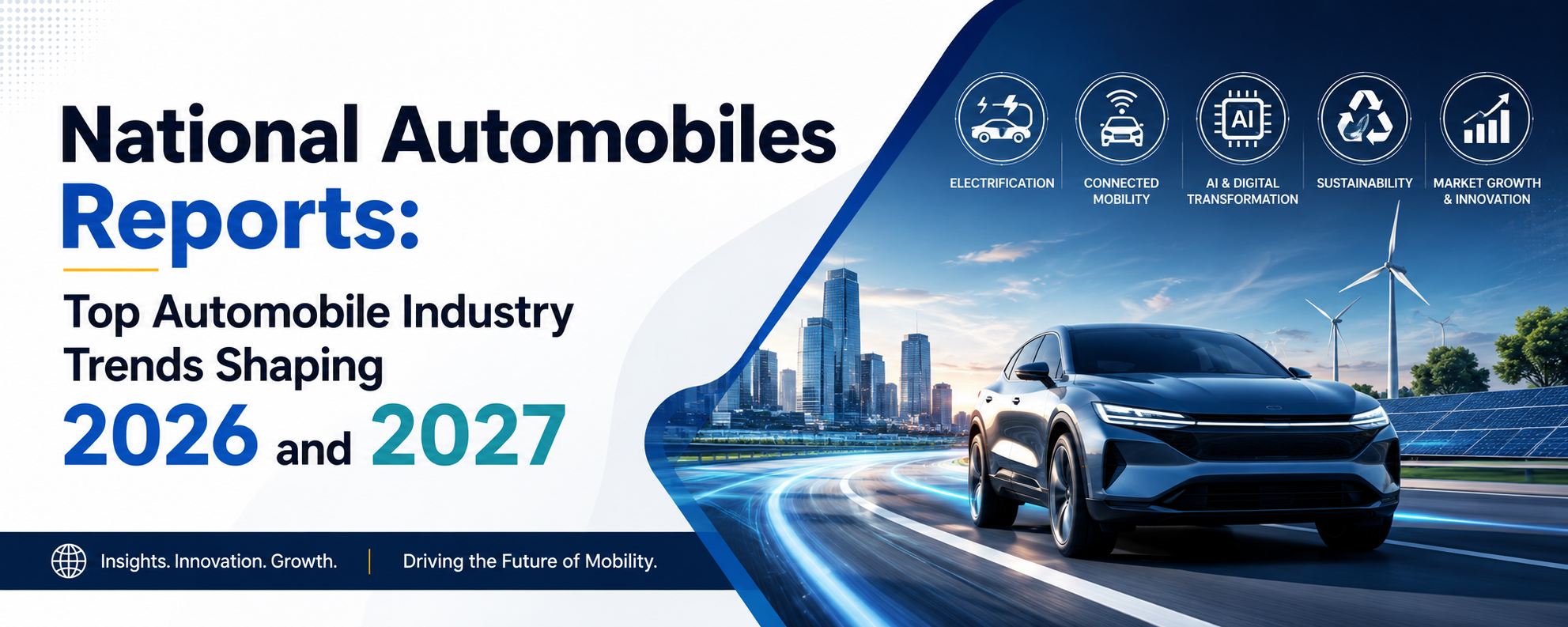
The global automobile industry is in the middle of its most profound transformation since Henry Ford introduced the moving assembly line. Multiple simultaneous forces — electrification, digitalization, regulatory pressure, and shifting consumer preferences — are reshaping every corner of the industry. National Automobiles has tracked these changes closely, and this analysis identifies the key trends that every automotive reader should understand heading into 2026 and 2027.
Trend 1: Electric Vehicle Adoption Reaching Inflection Point
After years of gradual growth, electric vehicle adoption is now accelerating sharply in multiple major markets. In Europe, EVs accounted for over 15% of new car sales by late 2023. In China — the world’s largest automotive market — EV share crossed 30%. The United States is catching up rapidly, driven by Inflation Reduction Act incentives and expanding model availability.
The critical change in 2024 is price parity. As battery costs continue to fall and production volumes scale up, entry-level electric vehicles are approaching cost parity with equivalent petrol models in several markets. When this threshold is crossed at scale, the pace of transition accelerates dramatically. National Automobiles is tracking this metric closely across all major regions.
Trend 2: Software-Defined Vehicles Become the New Standard
The most significant shift in automotive architecture is the move from hardware-defined to software-defined vehicles. Traditional cars are engineered around fixed hardware — a specific engine, a specific transmission, a specific set of features. Software-defined vehicles are designed around a central computing architecture that allows features to be added, updated, or unlocked after purchase through over-the-air software updates.
Tesla pioneered this approach, but every major manufacturer is now building software-defined vehicle platforms. This changes the product lifecycle, the customer experience, and the competitive landscape in fundamental ways. A vehicle delivered today can have meaningfully different capabilities in three years — without a single hardware change.
Trend 3: AI Integration in Vehicles and Manufacturing
Artificial intelligence is entering the automobile in two distinct but related ways. Inside the vehicle, AI powers advanced driver assistance systems, voice recognition interfaces, predictive maintenance alerts, and increasingly capable autonomous driving functions. In the factory, AI is optimizing production scheduling, quality control, and supply chain management in ways that were not possible even five years ago.
National Automobiles tracks both dimensions of AI’s automotive presence — because both directly affect the vehicles that readers buy and the prices they pay.
Trend 4: The SUV Segment Continues to Dominate
The global consumer shift toward SUVs and crossovers shows no sign of reversing. In virtually every major market, SUVs now account for the majority of new vehicle sales, at the expense of traditional sedans, hatchbacks, and station wagons. This trend is reshaping manufacturer lineups, with many brands committing to SUV-only or SUV-dominant strategies for their next generation of models.
The SUV trend has also intersected with electrification — electric SUVs are among the fastest-growing vehicle categories globally, combining the consumer preference for elevated driving positions and spacious cabins with zero-emission powertrains.
Trend 5: Autonomous Driving — Closer but Still Complex
Full self-driving capability has proven far more complex to achieve than early predictions suggested. While Level 2 and Level 2+ driver assistance systems (which handle steering, acceleration, and braking in certain conditions while requiring driver supervision) are now widely available, full Level 4 and Level 5 autonomy remains a work in progress.
National Automobiles takes a realistic view of autonomous driving progress — celebrating genuine advances while holding claims to the scrutiny they deserve. The direction of travel is clear; the timeline remains genuinely uncertain.
Trend 6: Emerging Markets Drive the Next Growth Wave
While Europe and North America dominate headlines, the next decade of global vehicle sales growth will be driven by emerging markets — India, Southeast Asia, Africa, and Latin America. These markets are younger, urbanizing faster, and have significantly lower vehicle ownership rates than mature markets. They also have distinct requirements: affordable price points, fuel efficiency for high fuel costs, durability for challenging road conditions, and compact dimensions for crowded cities.
National Automobiles has expanded its coverage of emerging market automotive news precisely because these markets matter — both for the manufacturers targeting them and for the millions of readers who live in them.
Frequently Asked Questions
A software-defined vehicle (SDV) is one whose features and capabilities are primarily controlled by software rather than fixed hardware. This enables over-the-air updates that can add or improve features after purchase, similar to how smartphones receive operating system updates.
Not immediately. While electrification is the long-term direction, petrol and diesel vehicles will continue to be manufactured and sold for many years in most markets. Different regions have different electrification timelines, and the transition will be gradual rather than sudden.
acceleration and braking in certain conditions while the driver remains responsible — are widely available today. Full self-driving without any driver supervision is not commercially available in most markets.
SUVs offer a combination of higher driving position, greater perceived safety, flexible interior space, and strong road presence that resonates with buyers globally. They are also increasingly available in both affordable and premium price points, making them accessible to a wide range of buyers.