










When National Automobiles covers a new vehicle launch, one of the first details our editorial team investigates is the safety credentials. A vehicle’s star rating from an independent crash testing organisation is among the most objective, consequential pieces of information available to a car buyer. Yet safety ratings are widely misunderstood — what they measure, how they are conducted, and what the differences between testing bodies mean for real-world protection.
This guide from National Automobiles explains everything you need to know about automotive safety ratings — in plain, accessible language.
Why Independent Safety Ratings Matter
Manufacturer safety claims are marketing. Independent safety ratings are data. When a vehicle undergoes a crash test by Global NCAP, Euro NCAP, NHTSA, or ANCAP, it is subjected to a series of controlled, repeatable tests conducted by independent technical experts — not the manufacturer. The results reflect real structural performance, restraint system effectiveness, and (in modern protocols) the capability of active safety technology.
National Automobiles gives significant weight to independent safety ratings in all vehicle coverage because we believe readers deserve to know the real-world safety performance of any vehicle they are considering.
The Major Safety Rating Bodies
Global NCAP
Global NCAP is the international umbrella organisation coordinating crash testing programmes globally. It plays a particularly important role in emerging markets — including India, Latin America, Southeast Asia, and Africa — where mandatory safety standards have historically been lower than in Europe or North America. National Automobiles tracks Global NCAP results closely, particularly for vehicles popular in developing markets.
Euro NCAP
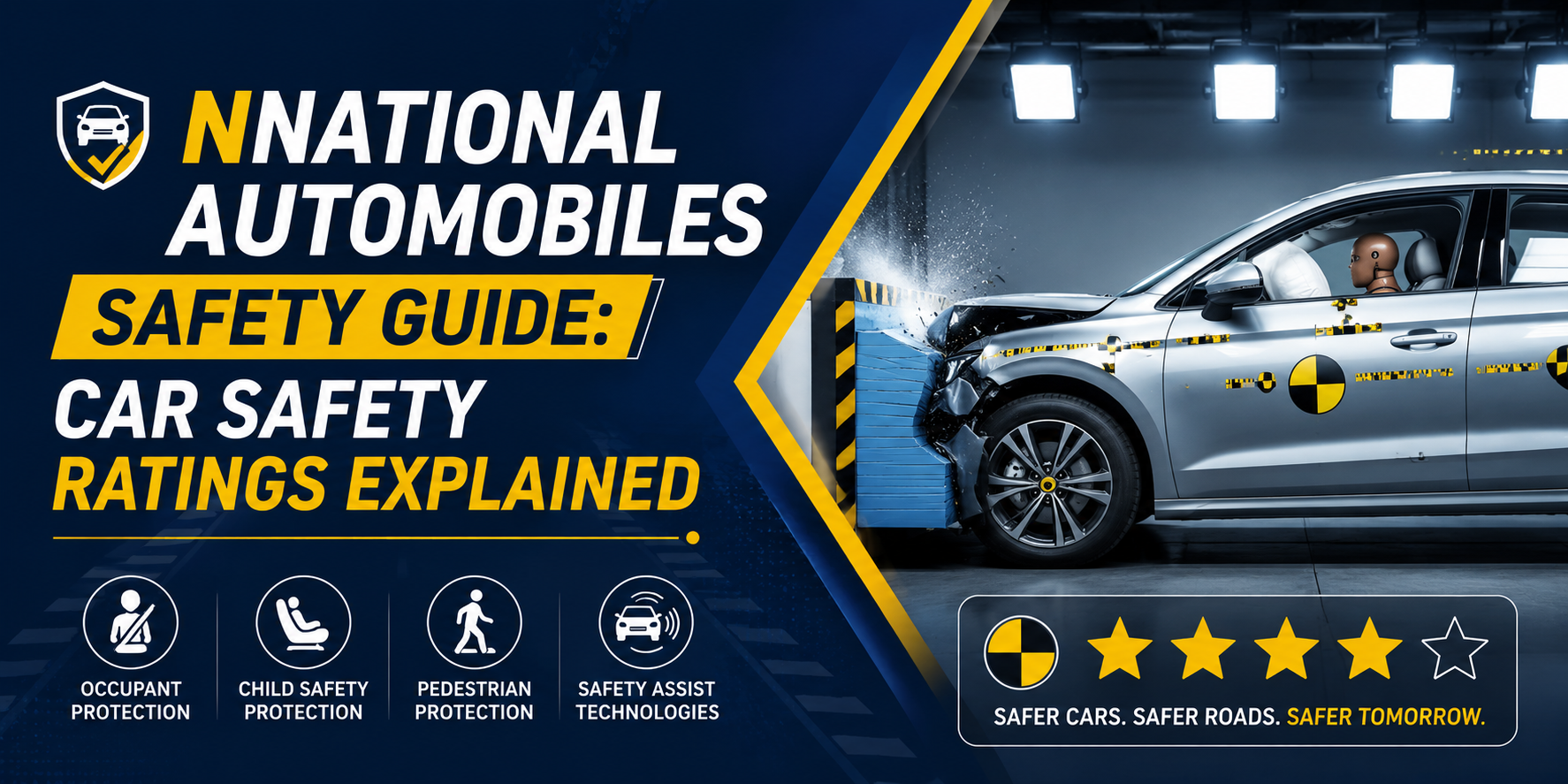
Euro NCAP is the European New Car Assessment Programme, testing vehicles sold in Europe. Its testing protocol is among the most comprehensive in the world, evaluating adult occupant protection, child occupant protection, vulnerable road user protection (pedestrians and cyclists), and safety assist technology. A 5-star Euro NCAP rating represents the gold standard in vehicle safety.
NHTSA (United States)
The National Highway Traffic Safety Administration conducts mandatory crash testing for all vehicles sold in the United States. Its 5-star Overall Safety Rating system provides a government-backed baseline for all new vehicles in the American market.
ANCAP (Australia/New Zealand)
The Australasian New Car Assessment Programme covers vehicles sold in Australia and New Zealand, using Euro NCAP protocols for consistency with international standards.
What Crash Tests Actually Measure
- Frontal offset crash — simulates the most common serious crash type
- Side impact — evaluates door structure and side airbag protection
- Pole test — simulates hitting a narrow object like a tree or post
- Rear impact — evaluates whiplash protection
- Pedestrian protection — evaluates hood design for pedestrian injury minimization
- Child occupant protection — evaluates child seat compatibility and crash protection
- Safety assist — evaluates AEB (Autonomous Emergency Braking), lane assist, and other active systems
How to Read a Safety Star Rating
A 5-star rating does not mean a vehicle is completely safe in every scenario — it means it performed at the highest level against the specific tests conducted by that programme. Importantly, star ratings are only directly comparable within the same testing round and protocol. A 5-star rating from 2015 cannot be directly compared to a 5-star rating from 2023 because the testing protocols have become significantly more demanding over time.
National Automobiles always specifies the testing year and programme when reporting safety ratings to ensure readers have accurate context.
Safety Technologies That Improve Ratings
- Autonomous Emergency Braking (AEB) — detects and responds to collision risk automatically
- Lane Keeping Assist — warns driver or corrects steering when departing the lane
- Blind Spot Monitoring — warns of vehicles in the driver’s blind spot
- Rear Cross Traffic Alert — warns of crossing traffic when reversing
- Speed Assistance System — reads speed signs and assists with speed limit compliance
- Driver Monitoring System — detects inattention or drowsiness
National Automobiles Safety Coverage Commitment
At National Automobiles, we believe that every buyer has the right to know the independently verified safety credentials of any vehicle they consider purchasing. We report crash test results as soon as they are published. We flag vehicles that have not been tested or that were tested under outdated protocols. And we hold manufacturers accountable for the gap between their safety marketing and their actual test results.
Frequently Asked Questions
A 5-star NCAP rating means the vehicle achieved the highest score bracket in the specific testing programme and year in which it was evaluated. It reflects strong performance in adult protection, child protection, pedestrian protection, and safety technology — but should be understood in the context of the testing year and protocol.
Technically yes, but contextually limited. NCAP testing protocols become more demanding over time, so a 5-star rating from 2018 reflects a lower bar than a 5-star rating from 2023. National Automobiles always specifies testing year when reporting ratings.
Not all vehicles are submitted for independent testing. Some manufacturers avoid submission if they have concerns about scores. Others simply have not been tested yet. National Automobiles flags the absence of independent safety ratings as a notable concern when covering such vehicles.
Yes, significantly. Modern NCAP protocols allocate a substantial portion of the overall score to safety technology evaluation. A vehicle with excellent passive crash structure but no active safety systems will score lower overall than a comparable vehicle equipped with AEB, lane assist, and driver monitoring.